HOW WILL YOUR BUSINESS SURVIVE POST COVID-19?


Is Your Team Still Focused?

Feeling flat? You are not alone. By now we have accepted the buzz word uncertainty has become the other buzz phrase, new normalBut, if we have come to terms with uncertainty, why is there still a feeling of monotony? Well, because there is no end game. There is no finish timeline. No set closure date. During these unclear times, as a leader you need to be asking yourself these hard but crucial 10-Point Action Plan questions:
  1. As their boss, do you know how to drive a remote team?
  1. Do you have the time to get around to every person every day or as often as required?
  1. How are they positively impacting your customers in this time?
  1. Do they have an engagement plan for the next two months?
  1. Are your employees focused daily?
  1. Are they contributing daily to the business?
  1. Can you see daily results?
  1. Are they meeting the KPIs?
  1. Are you driving and supporting them?
  1. What will happen to YOU AND your business if you fail to get momentum during this COVID-19 crisis?
 

WHAT IS YOUR 10-POINT ACTION PLAN FOR COVID-19?

  The first step of coming out strong on the other side of COVID-19 is to sustain the focus of your staff and team. Here’s how:
  • DON’T FEEL GUILTY ABOUT BEING HAPPY: When there is death and illness overwhelming the world and the current mood is solemn, there is a sense of guilt if you are seen to be jovial for fear of being seen to be mocking misery. But in the real world, emotions are inherent. A strong leader doesn’t avoid them but arouses the positive ones. Show your team that in hard times optimism and action are the way forward.
  • PURPOSE: We all want to know that we make a difference in the world – that’s called a yearning purpose. Wise leaders will let their remote employee know what they are doing is meaningful and productive and cleverly refashion daily tasks to satisfy that yearning purpose, which will yield results.
  • DAILY ASSURANCE: Sounds exhausting, but if kept brief and consistent it will bring out quality work in employees rather than stocking-filler to-do lists. A strong leader will on a daily basis elevate the remote communication to remind their staff that their work matters.
  • UNCERTAIN TODAY, CERTAIN TOMORROW: Talk about the future of the business and that the company’s future direction involves them. This ensures your employee knows their value and reinforces their hard work whilst unseen in a remote environment, is contributing to the bigger company picture.
  • DAILY GOALS: Perhaps the most vital tool in your kit is “the action list”. Make sure each employee has a daily to-do list that they will action. Inform them of pressing tasks but also provide them with the opportunity to set their own goals – ask them “what are the five key things you want to achieve today?” This both generates motivation and accountability – a proven formula for results.

In uncertain times make action and positivity a certainty.

To go through YOUR 10-Point Action Plan contact KONA :

1300 611 288 | info@kona.com.au
SIX TIPS FOR SMASHING A VIRTUAL SALES MEETINGS

PROSPECTING IN A PANDEMIC

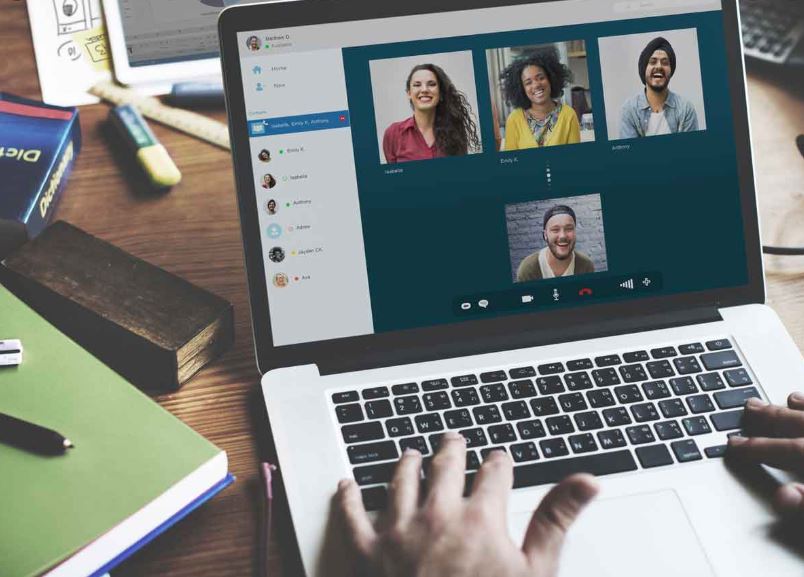
man at laptop in background, foreground image mask and keys in a table
A third of the Australian economy is generated from New South Wales, so what happens when that state goes into lockdown? Add to that Victoria in lockdown, and that is a sizeable portion of the nation’s economy taking a hard hit. We are once again in a situation where we need to be creative about how we are going to function and keep producing results. Virtual Sales Meetings are indeed back and look to be settling in quite comfortably for at least a month. So, do we stop selling and wait or do we power through and get busy smashing Sales remotely?
Imagine if at the start of 2020 you were told you can double the number of leads you see a day? Virtual sales meetings looks to be settling in quite comfortably as the preferred procedure moving forward. And used correctly this new modus operandi can work wonders for you, enabling you to see up to 10 times more prospects during a day than if you had to commute.
DIFFERENCE BETWEEN WIN OR LOSE
Acquiring and retaining strong professional sales relationships remotely is not as daunting as it seems in this new – online only world we are living in. As a Leader, is your sales team virtually afloat and motivated or really sinking? Are you as a manager making the right leadership decisions during this time of change?

MS Teams ZOOM meetings sales training with Brickworks

The simple truth is effective virtual communication skills could be the difference between winning and losing a sales deal. Just like in-person meetings, there are protocols to a sales meeting to bring about results. DOES YOUR TEAM KNOW HOW TO SELL EFFECTIVELY VIRTUALLY?

Here is both the why – and the how – of effective virtual sales to skyrocket sales results remotely.

 
1. PREPARE FOR THE VIRTUAL SALES MEETING FIRST
  • Make an Appointment: make sure you email an invite to all the participants to accept it – include a link to the web-conference into the invite and make sure you point out that it is a video meeting, so it is no surprise for the client.
  • Inform your prospect about your agenda, the questions you are bringing to the table and the goal you are both pursuing.
  • Provide your prospect with leeway to decide on the time that is convenient for them.
2. CONTROL THE MEETING
  • Encourage everyone to identify themselves before each contribution, “This is Fred from…”
  • As host, repeat questions that are asked of you before answering. Some participants may not have heard the question.
  • Remind participants before and during the meeting to keep their microphones on mute when they are not speaking.
  • If you are bringing in additional material via screen sharing, such as PowerPoint presentations or product demos to make the conversation even more productive, send the documents to participants in advance.

3. MASTER THE ART OF NON-VERBAL COMMUNICATION
Do your remote salespeople know how to listen to yield results?  Listening is key to selling. There, the secret is out. Active listening requires both ears and eyes. Ever watched a show on mute (no subtitles)? You get the idea of what is going on yes, but you miss key facts. Selling without listening is akin to watching tv with the volume down to zero.
Reading Non-verbal Behaviour
Most interpersonal communication (> 55%) is non-verbal. It may be a revealing facial expression, a particular style of body language, or the subtle yet telling flicker of an eye – these non-verbal communications are key to understanding the person in front of you and how to, in turn, effectively communicate with them. If more than half of what we communicate is non-verbal then more than half of what we are trying to say/sell is being missed if we cannot master our non-verbal styles.

4. ASK THE RIGHT QUESTIONS
Just because you are not in a person-to-person scenario does not mean you can be lax in your line of questioning. In fact, it is even more vital in video conferencing to ask the right questions in order to engage and hold attention in a remote set up.

The difference between you and your competitor lies in the questions you ask clients.

Do you and your salespeople possess Advanced Questioning skills?

Or does your competition question better than you?

5. OBJECTION HANDLING ONLINE
Humans are humans, their environment will change much faster than their mindset and behaviour, therefore being objectionable is a trait even the strongest virus won’t diminish. But to protect your sales armour against the inevitable objections that come in sales, even remotely – preparation is key. Do you know how to handle an objection on the spot during a video conference? Can your team handle the heat on their own when selling remotely?

6. BE EXCITING!
Video conferencing is the prime platform to show off your presentation skills. Everyone is video conferencing now, so you need to stand out – add some spark to your next sales meeting.

How will you build rapport?

How will you break the ice?

What presentation skills does your team have?

These remote SALES SKILLS are just the tip of the learning pyramid and make up part of your bespoke  REAL | Remote Education Active Learning Program* developed around your sales team and delivered remotely by the KONA Group. *The recent changes in work from home situations globally has seen access to our REAL Learning Program skyrocket, so we will continue to fill the learning spots on a first in first scheduled basis. Call 1300 611 288 or email info@kona.com.au to secure a spot.

CONTACT US: 1300 611 288

or

email info@kona.com.au

Work From Home Mojo | 5 Ways to Keep Your Team Motivated Remotely

Here we go again! Another lockdown, and another Work From Home set up. Yep. Work From Home (WFH). Now since the last episode of remote working, we have all progressed in our systems and processes. We have all established our own WFH routines and near mastered virtual meetings and the glitches that go with them.
But, one thing that will still test us and continue to rear its heavy head, is our motivation levels. No matter how many times we do this lockdown game, in fact the more we do it it seems, our mojo always at some point suffers.
Work From Home Mojo
You know something is set in place when it becomes an acronym – that is, WFH: Work From Home. But for some of us the trending hashtag #WFH is a bit of a WTF. Work From Home. It’s not an option nor a plea for management to gift you twice a week anymore, it is now mandatory, at least for the immediate future.
Now you have almost figured out how to manage your remote employees.
  • But have you any idea how to maintain motivation on a virtual scale?
  • How do keep your remote employees fully charged?
  • How essential is employee stimulus to the performance of your business?
Monitoring moral does not mean you need to change the entire business strategy. It just means that you need to make a little more effort to keep employees driven and feeling part of a team. The proven way of maintaining staff motivation is to show you care. Simple sounding right, but how? Care can come in the form of incentives or bonuses, awards, recognition and appraisals.

But the biggest indicator you care for your staff is what you invest in themThey will see that you care for their personal growth and success, and without batting an eye lid productivity will skyrocket – even remotely.

INVESTING IN YOUR STAFF BY UPSKILLING THEM SHOWS YOU CARE
Contact the KONA Group and we will not sell to you but help you tailor the best growth strategy for your team with focus on employee motivation and coaching the manager training. Keep your virtual team realistically motivated, focus on stimulating their ideas and maintaining their mojo. Here, we’ll get you started:
WEEKLY TEAM VIDEO CALLS

MS Teams ZOOM meetings sales training with Brickworks

Be connected by staying connected. Include everyone. Akin to a normal team office meeting, this will allow your employees to have their voices heard, literally, as well as allow space to air concerns as a network. There is a lot that can be understood from eye to eye contact.  
USE AN INSTANT MESSENGER SERVICE
It’s all well and good sending emails back and forth to one another, but even these can seem a bit too formal at times. Instead, have your employees use instant message platforms that come with video conferencing software, such MS Teams or Skype, to be able to quickly fire questions across to each other, or even just to chat, feel connected and build better working relationships with one another.  
TRUST THEM
Do you doubt your remote staff are actually working the required hours each day from the comfort of their home? It’s okay, they also wonder if you know they are working the required hours each day. It’s a two-way trust. And the key to letting go and trusting both your employee and in turn have them trust you, is belief – if you’ve hired the right people in the first place, you have to give them the autonomy to go away and get on with it. A lot of people will find that they’re more productive when working remotely for a team, as they feel they need to prove that they’re getting things done without the boss nearby to check in.  
APPRECIATE TO ACCELERATE
Ensure you’re providing incentives to help encourage your remote team members. Give plenty of recognition for the great work that they do, letting them know that it doesn’t go unnoticed, despite them not being present in the office. And, where possible, offer plenty of opportunity for learning, development and growth in their role.  
KEEP THE MENTAL STIMULATION UP
  Just like an office environment, WFH can also become stale for some staff, especially if they love to socialise and network with team mates daily. Throw a new project their way with a challenge attached. Ask them to design something completely out of their realm and see what they come up with. Set them a group task or an exercises that must be submitted in pairs.
Learn more from our Virtual Business Platform.

There is an entire day’s learning and more on how to stimulate, motivate and nourish your staff remotely – it’s just a matter of you opting to invest in your team to produce results for your business. Get motivated with KONA’s remote REAL Academy. Call 1300 611 288 or email info@kona.com.au and we will help.  

CONTACT US: 1300 611 288

or

email info@kona.com.au

Emotional Intelligence Profile

Psychological Profiling Tools Explained

What is an Emotional Intelligence or EQ Profile?

Emotional intelligence is the ability to sense, understand, and effectively apply emotions to be more collaborative and productive with others.

Successful leaders and superior performers tend to have superb emotional intelligence skills. The most intriguing aspect of emotional intelligence is that it is not fixed. With a little hard work and some ambition, emotional intelligence can be developed over time.

Emotional intelligence (EI) is considered to be one of the most desirable characteristics in a leader. One study found that individuals with high EI could be 40% to 122% more effective in positions involving influencing, managing, negotiating and/or serving others.
Our Emotional Intelligence EQ Reports provides a simple model for people to understand and develop emotional intelligence.

The Basics

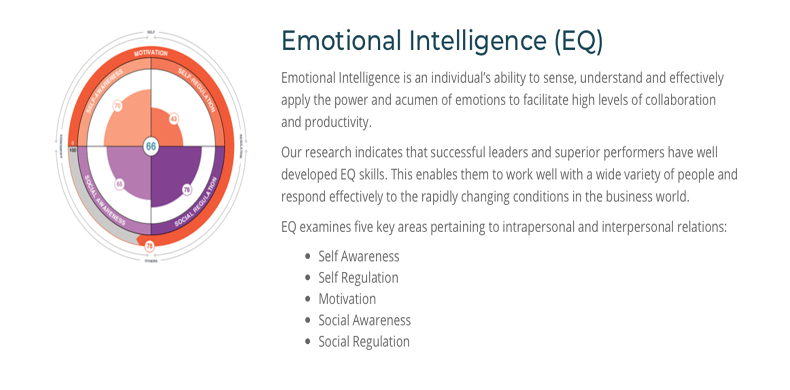
Emotional intelligence is composed of five distinct factors:

emotional intelligence header high res

Self-Awareness

The ability to recognise and understand our moods, emotions and drives as well as their effect on others.
(Goleman Definition – knowing your internal states, preferences, resources and intuitions)

  • Emotional Awareness – Recognising your emotions and their effects.
  • Accurate self-assessment – Knowing your strengths and limits.
  • Self-confidence – A strong sense of your self worth and capabilities.

Self-Regulation

The ability to control or redirect disruptive impulses and moods and the propensity to suspend judgement and think before acting.
(Goleman Definition – Managing your internal states, impulses and resources)

  • Self-control – Keeping disruptive emotions and impulses in check.
  • Trustworthiness – Maintaining standards of honesty and integrity.
  • Conscientiousness – Taking responsibility for personal performance.
  • Adaptability – Maintaining personal flexibility and adapting to change.
  • Innovation – Remaining comfortable with novel ideas, approaches and new information.

Motivation

A passion to work for reasons that go beyond money and status, and a propensity to pursue goals with energy and persistence.
(Goleman Definition – Emotional tendencies that guide or facilitate reaching goals)

  • Achievement drive – Striving to improve or meet a standard of excellence.
  • Commitment – Aligning with the goals of group or organisation.
  • Initiative – Readiness to act on opportunities.
  • Optimism – Persistence in pursuing goals despite obstacles and setbacks.

Social Awareness

The ability to understand the emotional makeup of other people.
(Goleman Definition – Awareness of others’ feelings, needs and concerns)

  • Understanding others – Sensing others’ feelings and perspectives and taking an active interest in their concerns.
  • Developing others – Sensing others’ development needs to bolster their abilities.
  • Service orientation – Anticipation and recognising the needs of others.
  • Leveraging diversity – recognising opportunities with and through different kinds of people.
  • Political awareness – Reading a group’s emotional currents and power relationships.

Social Regulation

The ability to proficiently manage relationships and build networks.
(Goleman Definition – Adeptness at inducing desirable responses in others)

  • Influence – Wielding effective tactics for persuasion.
  • Communication – Listening openly and sending convincing messages.
  • Conflict management – Negotiating and dissolving disagreements.
  • Leadership – Inspiring and guiding individuals and groups.
  • Change catalyst – Initiating or managing change with others.
  • Building bonds – Nurturing instrumental relationships and networks.
  • Collaboration and cooperation – Working with others toward shared goals.
  • Team capability – Creating group synergy in pursuing collective goals.
Emotional intelligence wheel chart image of profile.

How to Understand Your Emotional Intelligence EQ Report

Our first reaction to any stimulus is an emotional one. These emotions can both colour and distort our thinking and decision making. Our ability to recognise and manage our emotions is Emotional Intelligence at work ‐ and this is where your Emotional Quotient Report will point you in the right direction.

Emotional Intelligence has been said to be the fundamental difference in superior decision making and performance.

Your Emotional Quotient Report has been designed to give you an overview of your Emotional Intelligence based on the 5 fundamental pillars of Emotional Intelligence. One of the greatest things about Emotional Intelligence is that it can be cultivated and developed. The hallmark of superior performers is that they reflect on their experiences and interactions and search for ways to become more effective.

Emotional intelligence profile document cover.

Understanding the Reality and Power of Emotional Intelligence: perhaps the best definition is “Advanced Common Sense.

It is now clearly understood that decisions and actions are based on a blend of emotion and logic, and that the idea of a pure “logical” decision is misleading.

Emotions and the roles they play in decision making, problem solving, communication and behaviour are both necessary and vital to understand. We recommend that you read through your report with the above information in mind. It is important to reflect on the feedback in the report and think about any practical examples you may be able to apply.

Regardless of your scores and the feedback provided by the report you are presented with a wonderful opportunity to go to work on improving your Emotional Intelligence, thus improving your ability to become a superior performer who makes superior decisions.

Our Emotional Quotient™ or EQ report is available as a 13-page coaching and development report that has been designed to present emotional intelligence in a simple and effective model that can be applied immediately.

The EQ Profile is commonly used in the following functions:

Training and Development:

  • Leadership Development
  • Communication Effectiveness
  • Team Effectiveness
  • Sales Development
  • Customer Service Training
  • Coaching/Mentoring Relationships

Strategy and Management:

  • Change Management
  • Conflict Resolution
  • Culture/Transformation

Personal:

  • Personal Effectiveness
  • Family Relationships
  • Marriage Counselling
  • Career Planning

Download a free sample EQ Report Profile Sample+-+Emotional+Quotient.
If you looking to get yourself or team profiled, please contact us on 1300 611 288.

(FREE E-BOOK) 10 Ways to Increase EQ – KONA eBook

10 WAYS TO INCREASE YOUR EMOTIONAL INTELLIGENCE

Emotional intelligence free ebook image.

This e-Book makes a handy companion guide to go with an individual’s Emotional Quotient profile. At 14 pages, the e-Book briefly summarises the concept of emotional intelligence and explores 10 widely applicable techniques to start improving your EQ straight away.


WORK FROM HOME PROTOCOLS OF AN E-MEETING

Protocols of an e-meeting.

In uncertain times it is vital to keep your business active, busy as well as professional – that means ensuring your staff have a solid grasp on the dos and don’ts of E-Meetings and video conferencing as virtual workplaces become the new normal.

In light of these new challenges we face as business leaders, more and more of our clients are requesting virtual training, coaching and mentoring on the below topics, to mention but a few:

CONTACT US FOR MORE INFORMATION

It is important our Leaders and Managers embrace the shift in training and take on this platform as part of the development of their team.

Think about this, does your team:

  • Know how to behave in front of the camera?
  • Understand the art of non-verbal communication?
  • Have techniques to read the e-room?
  • Know how to hear not just listen in a virtual meeting?
  • Ask the correct question to captivate a segregated audience?

Work-from-home has many benefits, but it also has many pitfalls like how do you manage your staff remotely?

For a business to prevent the perils of a work-from-home set-up undermining productivity, managers must maintain face-to-face interaction with employees online – often. It’s not about ‘checking in’, rather it shows you care for how your staff are performing.

Here are essential tips for E-Meeting Protocols, however remember, the virtual employee has now become a professional discipline that needs to be managed, continuously.

CORRECT TECH

The correct software in a virtual workplace is integral.

There are plenty of cool tools and gadgets for a home office set up, but whatever the setup you go with – keep it simple.

Time means value in remote work, so you don’t want employees wasting their meeting times unnecessarily setting up devices and downloading software.

Also, by keeping things basic – using software like Skype, Facetime, and Teams, these platforms allow you to communicate virtually as well as exchange documents, view presentations and share screens.

 LIMIT TYPING

Some people find the sounds of people typing soothing, but many find it irritating, especially one finger keyboard pounders.

This applies in an office environment as well as in a virtual meeting. Be it typing notes or on the spot emailing – keep your hands well away from the keyboard in an E-Meeting.

Apart from not being annoying, you are also indicating to your fellow e-meeting participant that they have your full attention.

Note taking should be hand-written, for courtesy as well as information retention – you remember what you write better than what you type.

LIMIT DISTRACTIONS

Only keep programs open that relate to the E-Meeting.

One of the biggest indicators of disrespect is showing you don’t care – so avoid even the temptation to be distracted and keep personal tabs and programs closed during an E-Meeting.

And – stay away from your mobile!

MUTE THE MIC

Mute your microphone when you’re not speaking.

Unexpected sounds are just that – unexpected. A dog barking, children playing, sirens screaming down the street. This may not seem like much, but it can be distracting as well as annoying to the other E-Meeting participants.

So, keep the mic on mute and when it is your time to speak, un-mute the mic and talk.

SPEAK CLEARLY AND SLOWER THAN USUAL

Despite the advances in technology, connection break-ups and two-three second delays in E-Meetings are still common.

Get used to pausing after asking a question. But most importantly – speak clearly and concisely and articulate your words.

You are at work. You may not be at work but nonetheless you are working. So, dress like you would if you were at the office.

 GET DRESSED FOR WORK – EVERYDAY

You are at work. You may not be at work but nonetheless you are working. 

So, dress like you would if you were at the office.

Every E-Meeting ensure both your attire and presentation is professional.

In fact, dress for work everyday you are working from home – you’ll be more focused and productive because you’re already dressed to win.

When in an e-meeting, think about what is behind you.

THINK ABOUT WHAT’S BEHIND YOU!

Washing basket? Dirty dishes? Empty bottles from the night before? Avoid embarrassment to yourself and the business and always be conscious of what people can see in your house.

NO EATING

Would you crunch on chips or sip a slushie in an office board meeting? No. So don’t do it in an E-Meeting either. Unprofessional and messy.

Rule of thumb – if you wouldn’t do it, wear it, say it, eat it or show it in an onsite office meeting, don’t do it in an E-Meeting.

The KONA Academy Protocols of a E-Meetings Training covers all of the above tips in detail, as part of the E-Meeting Program, which also looks at:

  • Understanding the Behaviour of Your Audience
  • Reading the E-Room
  • Virtual Presentation Skills
  • E-Management Training: how to manage your team remotely

CONTACT US FOR MORE INFORMATION

To organise your team’s Protocols of E-Meetings Training contact KONA on 1300 611 288 or email info@kona.com.au


Good Leaders make Decisions

Decision making is at the core of solid leadership.

When a problem presents, a Leader must be able to make the call. A decisive leader that leads the team with strength, instils confidence and paves the path to progression.

If nothing happens then *nothing happens.

But Leaders be warned – decision making isn’t just about making the right call – it’s also about the Leader’s ability to bring people with them as well as the skills required to move on!

“Evil Prevails When Good Men Do Nothing” 

Strategic leaders gain their decision-making skill through practice, and practice requires a fair amount of action.

“Action generates action. Inaction generates nothing.” – Garret Norris | CEO KONA | HBB Group

Strong leaders make strong decisions, then take action – pushing power downward, across the business, empowering people at all levels to make decisions. Distribution of responsibility gives strategic leaders the opportunity to see what happens when they take risks. But more importantly – it increases the collective intelligence, adaptability, and resilience of the business over time, by harnessing the wisdom of those outside the traditional decision-making hierarchy.

Decisions made by good Leaders are never off the cuff, in fact they are made by keeping in mind the long term as well as the short-term plans of the business.

And there is in fact a golden rule to decision-making and leadership, and it should not be kept secret, instead shouted from roof tops for all to hear – from business leaders, to sales leaders, to health care leaders to leaders of nations – objectivity! The best results for all involved in a decision-making process is one that is made by a rational leader based on evidence and facts.

“Emotion for Home, Passion for Business” – Garret Norris.

Strategic decision-making skills in Leaders is part of the pillars of strong leadership.

“Be willing to make decisions. That’s the most important quality in a good leader. Don’t fall victim to ‘ready-aim-aim-aim-aim syndrome’. You must be willing to fire.” – T.Boone Pickens, American Financier.

Are you afraid of making decisions?

Good Leaders always need to be refining their decision-making skills to build effective and productive teams. Make a Decision Now  – sharpen your leadership skills. Contact KONA on 1300 611 288 or email info@kona.com.au or do nothing (remember what happens when we do *nothing ↑ ).


PROSPECTING IS LIKE DATING | BUT ARE YOU COURTING YOUR CLIENTS INSTEAD OF SWIPING RIGHT?

Sales is no different to dating with both requiring a skill set that begins with the assessment of a stranger through to engaging interest in order to ensure you see each other again.

But from the turn of the 20th century to the present day, the pursuit of romance and similarly a Lead, has been an evolving part of culture.

Remember the gentleman caller of the early 1900s, followed by the days of courtship mid century, and the 80s where the anticipation of love was symbolised by a blinking answering machine light, the evolution continued from dating sites to the now simple direct method of swiping right on an app.

The sales journey is no different, the travelling sales man using public phone boxes evolved to mobiles, contacting Leads by fax is now a click on an email and, client social gatherings in pubs to form credibility has now become connections on Linkedin.

In both sales and dating, the biggest shift over time is in how we communicate effectively with a stranger to establish an ongoing relationship.

But you must keep up with the changes to stay in the game.

The sales environment is changing rapidly and continuously and this can impact conversion rates and how you hit your targets.

The changes can be varied and numerous – in the way you connect with prospects, differentiating from your competitors and how you position yourself – that is why there is a dire there is a need for businesses to establish an understanding of these changes and gain skills to learn how to adapt to change in order to keep up with industry shifts.

Technology has helped selling come a long way. And when it comes to sales and marketing, change is the name of the game. In fact, just when you think you’re getting the hang of things, you realise that you may be lagging behind.

So how does a Sales Specialist keep up with ever-changing trends in this dynamic field? After all, the competition isn’t going to stop. Staying on top of industry changes can be easier than you think however. Here are a few quick techniques:

STAY CONNECTED

Networking with industry minds on social media is a beneficial way to stay in the loop of any movements in your field. Communicating through posts, or simply digesting news articles keeps you informed and moving forward.

INFORMATION ALERTS

Stay informed by being notified. Having alerts and email notifications switched on and refined to professional topic that interests you will keep you up to date with your industry changes.

READ

There is certainly a vast landfill of unclean data out in the Blogasphere, but if you if you dig deep enough you may just unearth some hidden treasurers that should provide you with some valuable knowledge, after all: “Information = Knowledge, Knowledge = Confidence, Confidence = Attitude,  Attitude = Success”Garret Norris | HBB Group CEO.

PICK UP THE PHONE 

The online world can deliver you some gripping information, but there’s something quite valuable and unique to be gained from having an actual vocal conversation – it opens up a very different world of insights into the needs of the person you are exchanging words with. It’s only once you’ve understood how to address these needs that you’ll have a clearer understanding of where your industry is heading.

These techniques are immediate actions you can make in your effort towards adapting to change, the long term goal is in changing your mindset.

To learn the KONA Mindset to accept change, contact the KONA Group today on 1300 611 288 or info@KONA.com.au for a confidential and informative conversation.

“Nothing Changes if Nothing Changes”

Call Centre Sales Training

Call Centre Sales Training Australia

Skilled call centre staff who are truly an asset to your organisation when they are:

  • Adept at handling different kinds of situations
  • Convert leads into customers effectively

Transform the Results of Your Call Centre People

If you are looking to transform your call centre employees into confident product advisors, who get results no matter what, contact us at KONA today.

With over 17 years of experience and a proven track record, KONA will help deliver results for your call centre. We will customise your call centre training in Sydney to suit your organisation’s industry and goals to ensure you derive the maximum value from your investment.

Call Centre Training and Sales Training Courses in Sydney – How We Can Help

Our specialised, Call Centre training and Sales Training programs will teach your executives to become more confident communicators, overcome objections gracefully and close sales calls effectively. They will learn all the crucial skills to become effective call centre executives including relationship building, cross selling, up selling, closing techniques and even outbound cold calling, when required

We also have Team Leader training programmes exclusively cater to training Team Leaders who will learn how to motivate their teams, improve the KPIs achieved and conduct one to one coaching for the executives.

Call Centre Training and Sales Training in Australia Results

Here are some of the results our clients consistently achieve after initiating our call centre sales training programs.

  • Reduction in staff turnover
  • Increase in product sales
  • Increase in repeat sales
  • Increased cross selling and up selling
  • Reduction in average call time
  • Reduce escalations
  • Increase the rate of first call resolution
  • Increased confidence in handling sales calls including outbound calls
  • Increased customer satisfaction

The Most Effective Australian Call Centre Training Program

When you are looking to truly improve the performance of your call centre executives and team leaders, KONA’s Customised Call Centre Training, Sales Training in Sydney and Customer Service Training and Coaching will increase your team’s performance and results

Generic, ‘off the shelf’, by the book, Call Centre Training Courses do not deliver effective results and they are not the best use of your investment if you are looking to develop a highly effective team that deliver the results you need.

So if you are looking to increase the effectiveness and results of your Call Centre and Customer Service team, contact KONA today on 1300 611 288 or text 0425200883 or email info@kona.com.au to discuss how we can help you to improve your organisation’s results.

The KONA Group is Australia’s Leading Call Centre TrainingSales Training and Sales Management Training and Coaching company and provide customised training programs that include:  Sales Training & CoachingSales Pipeline TrainingKey Account Management TrainingCall Centre Training & coachingCustomer Service Training, Negotiation Skills Training & CoachingMotivational SpeakersHR ConsultingDISC and more.