Gap in revenue

Your VC-backed business has a revenue gap. Here’s why it never closes and what to do about it

Most VC-backed businesses don’t fail because of bad products or bad markets. They fail because the revenue engine was never built to last – By Garret Norris – CEO, KONA Group

I’ve spent 25 years working inside revenue teams across Australia and New Zealand. From FMCG to financial services, pharmaceuticals to professional services, and the pattern I see in VC-backed businesses is almost always the same.

The business has real potential. The management team is capable. The product is solid.
But the revenue engine is propped up by one or two heroic individuals, the forecasts are gut-feel at best, and the board conversations are more hope than data. That’s a problem KONA was built to solve. And after 25 years, we know exactly where to look.

Revenue gap

The five constraints that keep revenue underperforming

When I sit down with a management team for the first time, I’m looking for one of five things. Usually we find more than one.

Prospecting: The pipeline isn’t full because the team doesn’t have the confidence or consistency to prospect at the right level. Activity looks busy. Results don’t follow.

Qualification: The pipeline looks full, but with the wrong deals. Time and energy are being invested in opportunities that were never going to close.

Conversion: The team can open conversations. They can’t close them. Deals die at proposal or negotiation, and no one quite knows why.

Velocity: Deals sit. The team manages stalled opportunities instead of building new ones. Cash flow suffers. Forecasts slip.

Leadership: The sales manager is reactive. Coaching is inconsistent or absent. The team underperforms not from lack of skill, but from lack of direction.

“Most management teams know the revenue gap exists. Few have the tools to close it systematically, or the data to show the board how they did it.”

What 100 days can actually change

We don’t run programs. We build sales engines. In the first two weeks, we establish a clear, honest baseline, what’s working, what’s broken, and where revenue is being left on the table. No spin, no surprises.

By day 30, we’re coaching on stalled deals and recovering pipeline. Management has real momentum to show the board.


By day 60, the team is operating with a shared methodology – common language, consistent process, measurable benchmarks.


By day 90, the Sales Director is leading, not just managing. The pipeline review cadence is established. We’re in support mode.

At day 100, management presents a performance report, not a narrative, but actual data showing what changed, what was recovered, and what the next 12 months look like.

10–25%
Conversion rate improvement within 90 days

15–30%
Reduction in sales cycle duration

15–35%
Upsell & cross-sell revenue increase within 6 months

3–7 years
Average client retention across our portfolio

These aren’t aspirational targets. They’re the outcomes we’ve delivered across 25 years and multiple market cycles, including the Asian financial crisis, the GFC, and COVID-19. Tracked, reported, and owned by the management teams who achieved them.

Investors

What this means for investors

VC and PE investors often ask me the same question: how do I know the revenue performance is real and repeatable, not just a good quarter?


The answer is structure. When a sales team has a shared framework, a qualified pipeline, and a leader who is coaching proactively, the results become predictable. Forecasting accuracy improves. Dependency on the founder or CEO reduces. The business starts to look like something that scales — because it is.

Our structured quarterly reporting is written in the commercial language of a boardroom, not a training report. It translates sales activity and capability data into investor-grade insight.

“When management wins on revenue, everyone wins. Our job is to make management look brilliant by making the revenue results impossible to argue with.”

We back this with a guarantee

Most consultancies won’t commit to outcomes. We do. KONA commits to measurable revenue improvement within the first 100 days. If we don’t deliver, we refund our fees. You commit to the process. We commit to the result. No negotiation. No fine print. 25 years and counting.

Client results: what the numbers say

The following results are drawn from KONA engagements across Australia and New Zealand.

They represent outcomes management teams achieved and owned.
• 80-person sales team: sales doubled in 6 months
• Finance sector client: revenue increased by over 20% in one year
• Pharmaceutical client: sales increased 19%, achieving 140% of annual target in one year
• Industrial client: market share grew from 32% to 40% in 2 years
• Building sector client: market share grew over 5% in a declining market within 18 months
• Media client (Nova): results increased 50–100% in key areas within 10 months

VC

If this sounds familiar

If you’re leading a VC-backed business or advising one, and the revenue engine isn’t performing the way the model said it would, I’d welcome a direct conversation. Not a pitch. Not a proposal. A 30-minute diagnostic conversation about where the primary constraint is most likely sitting in your business right now.


“You set the targets. We help you hit them. And we build the evidence base that makes sure everyone knows you did.”

Get in touch
Garret Norris · CEO, KONA Group
garret@hbbausgroup.com.au · +61 422 847 660 | kona.com.au | 1300 833 574


Author – Garret Norris – https://www.linkedin.com/in/garretnorris/

Garret Norris -KONA Training

Six Key Achievements of Planning

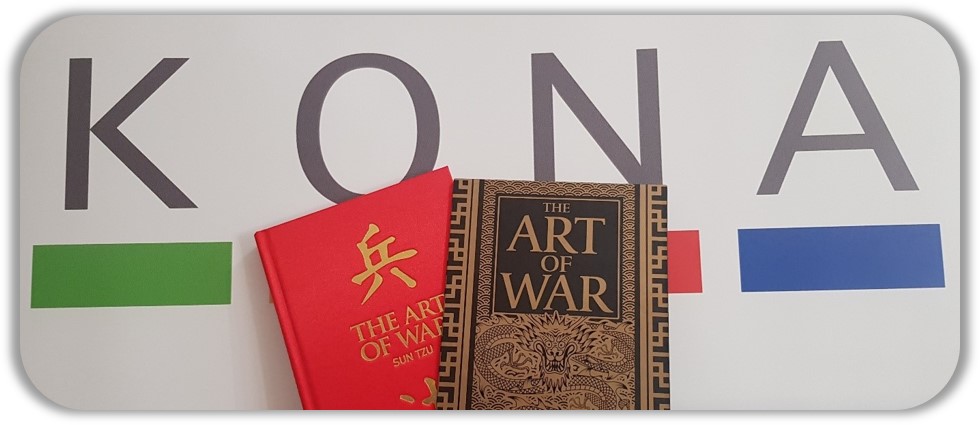
KONA logo with two 'The art of war' books.

“The general who wins the battle makes many calculations in his temple before the battle is fought. The general who loses makes but few calculations beforehand. Thus, do many calculations and lead to victory, and few calculations to defeat; how much more no calculation at all! It is by attention to this point that I can foresee who is likely to win or lose.”

Sun Tzu

Sun Tzu was a Chinese general, military strategist, writer and philosopher who lived in the Eastern Zhou period of ancient China. Sun Tzu is traditionally credited as the author of The Art of War, an influential work of military strategy that has affected both Western and East Asian philosophy and military thinking.

Full name: Sun Tzu Born: 544 BC Died: 496 BC            

Every Business must have a Plan

Regardless of your working situation, COVID or not, every business must have a plan.

Does your team know what success looks like?

A PR report has found in the current situation we are facing, only 10% of communication executives have done extensive planning.

Recent research has found that approximately 80% of business fail within their first year of operation, while 25% do not have a business plan. It is no coincidence that these two facts are linked – proper planning, budgeting, and forecasting are all an essential part of success.

How can you create a successful business when you do not know where it is going?

Thinking about the future means learning to think differently. Change is everywhere and pops up at any time, as COVID has proven.

How do you combat change in a business environment?

Change challenges all our current practices whether we like it or not. Change challenges:

  • Mindset
  • Decisions
  • Policies
  • Products                         

Implementing the The Three Horizons (3H) Growth Model.

This process when taught to your leaders and team correctly and rolled out immediately, re-frames your team’s thinking to produce results and hit every KPI set.

Three horizons growth model.

The 3 Horizons Growth Model is a learned process that bridges today to tomorrow.

Why Train Your Team and Yourself in the Three Horizons 3H Growth Model?

By implementing the 3 Horizons Growth Model across your business you instantly address and benefit from the Six Key Achievements of Planning:

1. Measured Improvement

What can be measured, can always be improved. A 3H business plan gives you direction and focus in Sales, ensuring you and your team meet KPI. It is only through improvement and growth that a business and employee can maximise profitability.

2. Projected Growth

With a 3 Horizon’s plan in place, you can meet goals ahead of target, which then allows you to think about – what to do next? In other words – GROW. By consistently monitoring and improving your business plan you begin to set achievable goals for growth. When change occurs, you are then able to evolve with the challenges.

3. Progressive Mindset

When you and your team start operating under a 3 Horizons mentality you all begin to operate from the same manual. The entire organisation’s thinking becomes focused on the wider scope and the impact the team’s current day activity has on future results.

4. Team Cohesion and Drive

What is the business’ value proposition?

Does the team agree on a set definition?

Are you all uniform in the eyes of the customer?

A business plan with 3H in place ensures the company’s philosophy is not only front of mind but also actioned daily.

5. Customer-Centricity

Customers are actually more attracted to a bespoke offer that connects them, rather than a one-size-fits-all agreement. Does your team know how to profile a customer? You must have a customer centric plan in place to be able to help the customer that comes knocking.

How will the business operate without a plan? Most businesses fail because of poor Sales Management. Consider the activities the team is going to perform in order to generate revenue in a month, three months and six months. A plan is only the start of the process – but everything has a start or it goes nowhere. Do you have a plan on how to deliver your goods or services on time and to the standards required?

6. Education

Employee knowledge base is the most essential part of a business. What tailored training and education support do you have in place to maximise the intellectual power of your team? Their knowledge is your ROI.

Planning is a crucial part of business life – without a plan for results you are simply left with a plan to fail.

The 3 Horizons Growth Model is being rolled out globally by the KONA Group. DOES YOUR TEAM HAVE A PLAN?

The recent changes in work from home situations globally has seen access to our R.E.A.L Academy (Remote Education Active Learning) skyrocket, so we will continue to fill the learning spots on a first in first scheduled basis. Call 1300 611 288 or email info@kona.com.au to secure a spot.

Call 1300 611 288 or Email info@kona.com.au


Good Leaders make Decisions

Decision making is at the core of solid leadership.

When a problem presents, a Leader must be able to make the call. A decisive leader that leads the team with strength, instils confidence and paves the path to progression.

If nothing happens then *nothing happens.

But Leaders be warned – decision making isn’t just about making the right call – it’s also about the Leader’s ability to bring people with them as well as the skills required to move on!

“Evil Prevails When Good Men Do Nothing” 

Strategic leaders gain their decision-making skill through practice, and practice requires a fair amount of action.

“Action generates action. Inaction generates nothing.” – Garret Norris | CEO KONA | HBB Group

Strong leaders make strong decisions, then take action – pushing power downward, across the business, empowering people at all levels to make decisions. Distribution of responsibility gives strategic leaders the opportunity to see what happens when they take risks. But more importantly – it increases the collective intelligence, adaptability, and resilience of the business over time, by harnessing the wisdom of those outside the traditional decision-making hierarchy.

Decisions made by good Leaders are never off the cuff, in fact they are made by keeping in mind the long term as well as the short-term plans of the business.

And there is in fact a golden rule to decision-making and leadership, and it should not be kept secret, instead shouted from roof tops for all to hear – from business leaders, to sales leaders, to health care leaders to leaders of nations – objectivity! The best results for all involved in a decision-making process is one that is made by a rational leader based on evidence and facts.

“Emotion for Home, Passion for Business” – Garret Norris.

Strategic decision-making skills in Leaders is part of the pillars of strong leadership.

“Be willing to make decisions. That’s the most important quality in a good leader. Don’t fall victim to ‘ready-aim-aim-aim-aim syndrome’. You must be willing to fire.” – T.Boone Pickens, American Financier.

Are you afraid of making decisions?

Good Leaders always need to be refining their decision-making skills to build effective and productive teams. Make a Decision Now  – sharpen your leadership skills. Contact KONA on 1300 611 288 or email info@kona.com.au or do nothing (remember what happens when we do *nothing ↑ ).