5 Ways To Improve Your Sales Pitch

A Sales Pitch is a personalised and well-constructed presentation.

Having access to a world of information at our fingertips means today’s buyers are more informed than ever.

So how can you improve your sales pitch and ensure you secure the sale?


Here are 5 tips to improve your sales pitch.


1. Do Your Research

Creating a great pitch requires you to understand your customer. Doing market research will help you get to know your customer’s needs.


You should look at your prospect’s website and utilise LinkedIn to gain knowledge of what they do and what their needs may be.


2. Know How To Overcome Objections 

Objection Handling Sales Skills - The Digital Sales Institute

Knowing how to handle objections will:

  • Help build relationships
  • Establishing yourself as being experienced
  • Helps the salesperson determine whether a real opportunity exists


3. Listen To Understand

Active listening will give your prospect confidence in your service.

Listening to understand saves time and frustration in the long-run as you will become aware of your prospect’s needs.


4. Think About The Value Your Product Or Service Brings

Professionals who can show the value of their product above price will stand out to their prospects.

People buy products or services for the value it will give them. So it’s best to educate your prospects about value rather than just focusing on features.


5. Connect With Your Prospect
Introduction to social media | Digital Ready

It is important to connect with your prospect personally and on social media.

Some benefits of connecting with your prospect include:

  • You are more likely to make the sale- people are more likely to conduct business with those they have positive rapport with
  • Shows your prospects a more personal side of you, not just business
  • Creates a better customer experience


Have you considered how your salespeople can improve their sales pitch?


Contact KONA to discuss tailored options to enhance the performance of your sales team!


Contact Us Button PNG Images Transparent Background | PNG Play

4 Selling Techniques For Social Media And Beyond

Salespeople have been presented with a new landscape in the rapidly changing digital-age

The right way to approach social sales is one of the most valuable things today’s salespeople can learn.

Here you will find 4 effective selling techniques for social media and beyond.


1. Have A Marketing Approach

To be successful in sales, some of your practices should be marketing techniques.

Although there is a distinction between a marketer and a salesperson, it’s important for salespeople to incorporate marketing into their sales process.


2. Technology Has Shifted Sales Conversations

Sales conversations aren’t what they used to be. Nowadays prospects can:

  • Research your company
  • Research you
  • Know everything you have to offer

Now, the techniques formerly used to approach customers and start sales conversations have changed. And you need to know how to navigate this situation.


3. Connect Online And In Person With Your Customer


The ‘social’ aspect of selling is more about building relationships than selling a product or service.

You have to make a real connection with prospects, and not just make a transaction.

This approach is more time consuming, but is packed with benefits. It results in having trusting and loyal relationships with customers.


38 Social Selling Statistics You Need to Know for 2023


4. Face-To-Face Interaction Is Still Important


Making connections in a social media sense is important, but doesn’t outweigh the importance of having face-to-face meeting with your customer.

 Nowadays many salespeople make the mistake of thinking social media is all they need.

A face-to-face meeting will always create a more personal and trusting connection than an online connection.

Contact KONA today to discuss how you can make your sales process more personal & effective!


4 Reasons Why Sales Persistence Pays Off

When it comes to selling, the right amount of persistence is critical.

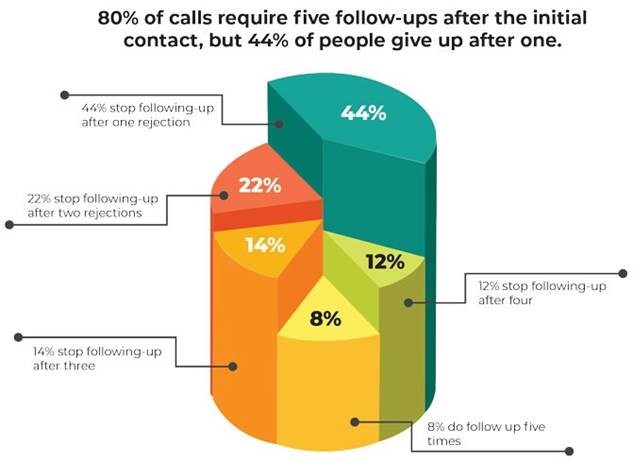
Statistics tell us – calling until you make the sale – works.

However! 90% of salespeople give up after just four calls.

This graph shows that 8% of the sales people are making 80% of the sales:

Here are 4 reasons why it is beneficial to be persistent as a salesperson.

1. It Makes You Stand Out From The Crowd

Most salespeople are not persistent.

Studies have found that almost 50% of salespeople give up after the first call.

Typically salespeople get caught up in active business, instead of following up prospective customers. Follow up your prospects with more calls than your competition, and you’re already ahead!

2. Increases Customer’s Confidence In You

Persistence will –

  • Increase the customer’s confidence in you.
  • Keep you at the top of their list when they are ready to buy.
  • Give your prospect an insight into your dedication and work ethic. However, you also need to be able to gauge when it is time to call it quits.

3. Demonstrates Dedication & Purpose

The right amount of persistence will show your prospects that you are dedicated, and truly passionate about the product or service you are offering.

Persistance assists with –

  • Building relationships, as prospective customers will see that you have purpose.
  • You can prevail through challenges.
  • It will give you a better understanding of what the customer needs.

4. Motivates You To Try Harder & Shows You The Value Of Success

Persistence helps you to discover that each failure is another learning experience. When you have a successful sale after being persistent, you quickly realise that the hard work does pay off.

The most difficult clients are the hardest to lose. Why? It takes discipline and persistence to gain their business. And 90% of salespeople don’t have it.

Sales persistence is not merely calling until you make a sale, it is knowing how to properly navigate the sales process from the beginning.

Persistence does not always come naturally, it’s a learned trait when mastered can be incredibly valuable.

Are your sales team persistent?

Contact KONA for customised Value Sales Training for your team and stay ahead of you competitors!

4 Reasons Why Sales Training Should Be A Component Of Your Recruitment Strategy

When recruiting new team members for your business, there are many considerable factors to ensure your offer is most appealing to your target recruit. Generally, companies will hire established salespeople with the assumption that they won’t need further training. In doing so, you could be missing out on the opportunity to grow and develop the next top salesperson.

Here are 4 reasons why you should implement an offer of sales training into your recruitment process:

1. You Are More Likely To Retain Staff When You Offer Ongoing Training


Offering ongoing training to employees will make them feel valued. It attracts the right type of person to the role, someone who is eager to enhance their skills and wants career progression. Going into a new job knowing you will have opportunities to learn and develop new skills naturally boosts enthusiasm. Not to mention your business’ recruitment costs will reduce when you have a high staff retention rate.

2. Be Proactive, Not Reactive


It is common for businesses to only consider training their sales team when there are problems emerging. A more effective strategy is to offer staff training regularly. This will prevent problems before they occur and ensures any issues are stamped out early on. Incorporating Sales Training into your recruitment process will ensure any new staff that come on board are trained in the same way as your current salespeople.

3. Attract A Quality Candidate To The Position


Proposing a training program in your employment offer is attractive to prospective employees as it eases tension related to taking on a new job. It opens the doors to people who may not have a lot of experience in the field, but they are eager to learn and with the right training, could be the next best salesperson on your team.

4. Promotes An Encouraging And Supportive Work Environment

Sales Training has a positive influence on staff enthusiasm, engagement, and fulfilment. Offering training opportunities at the recruitment stage promotes your business as being supportive. It shows you have intent for employee growth within the company. Offering sales training from the beginning of a salesperson’s career demonstrates that your company is willing to invest in their team.

You can achieve these benefits and more by offering effective training as part of your recruitment process.

Find out how you can incorporate Sales Training into your recruitment strategy by contacting KONA!

Phone 1300 611 288 or email info@kona.com.au

Manifest success

“That Which You Manifest Is Before You.”

This is one of the most profound statements I have ever heard.

It is in one of my favourite books – The Art of Racing in the Rain by Garth Stein.

Such a simple concept, yet so true: “That which we manifest is before us”; we are the creators of our own destiny.

Be it through intention or ignorance, our successes and our failures have been brought on by none other than ourselves.

I think this is wonderful … and yet scary at the same time.

So all my successes I created?  Fabulous!  But wait a minute – if I’m not as successful as I want to be, then I created that too?  Horrors!  And my absolute failures, I created those too?  That’s a worry.

But let’s look at the positive.  We can create our own future.  It’s like The Secret. “What you think about and thank about, you bring about.” And other smart sayings: “If it’s to be, it’s up to me.” And the classic Michael Jackson line “I’m starting with the man in the mirror…take a look at yourself, and then make a change.”

We all have that potential to be M.A.D. (to make a Difference).  It starts with deciding what you want, what will make you happy, what’s important to you – and then writing it down.

So that’s Step 1: Write it down, record it, post it, tell someone about your plans.  Commit your dreams to paper (or the world-wide web) and it will become reality.

Step 2: Create stepping stones to get you over the troubled waters and to the other side – break it down into bite-sized pieces, so that you can achieve (and celebrate) small goals along the way.  Measure the steps that you are taking.  I love To-Do lists where I can tick off the things that I have accomplished each day.

Step 3: Ensure that you make your dreams ARE achievable.  After all, you DO want to be able to applaud your effort and not finding that you are depressed by every little obstacle in the river of life that may come your way.

Step 4: Is it possible to be CEO of a company that you just started with within a year?  Probably not! (Although for some Gen Y and Gen Xs that’s exactly what they want … and expect.  But that’s another conversation altogether!) Be realistic about your wants and needs.

Step 5: Put a date on your dreams.  Goals are dreams with a timeline.

Hmmm, seems like I’ve just written down S.M.A.R.T. goal-setting.  Specific, Measurable, Achievable, Realistic and Timely.

Well then, let’s start to manifest our destiny!


Get Your Sales Team To Use Only Selling Techniques That Work! (Infographic)

Sales training courses are a dime a dozen. For the most part, they’re good…conceptually. Its execution though, generally sucks. It’s at this stage that the kinks and the glitches almost inevitably appear due to either, the implementing guidelines are too complex and not too specific, or the sales reps aren’t motivated enough, or in some cases, simply don’t care. You can’t have a situation like this and stay in business for long. It’ll cost your company too much.  It’ll also cost you your job. What follows are 5 tried and tested selling techniques. They work. They work because they make sense and are easy to adopt. These are no-fuss, straight-to-the-point selling approaches every salesperson should have as an integral part of his selling arsenal. Get Your Sales Team To Use Only Selling Techniques That Work! (Infographic)

5 Principles to Identify If You Are Developing a Competent Sales Team

5 Principles to Identify If You Are Developing a Competent Sales TeamTo build an efficient and competent sales force, Sales Managers and Sales Leaders have to establish a Sales Management philosophy and process. One of the keys to sales success is in the 5 Indicators of Sales Force Effectiveness and by adhering to the following principles, you can go a long way to establishing a successful team.

1. Don’t Under-Lead or Under-Manage

In KONA Group’s Customised Sales Training and Sales Management Training workshops we regularly notice that Sales Managers are Coaching from behind their desks and relying on CRMs, reports, metrics and deadlines to manage and motivate their teams. They think reports and numbers can fire up their teams however truly effective Sales Managers look for ways to lead by their presence and example by being involved. Ask yourself and/or your Managers this question – How many days have you actually spent on the road Sales Training and COACHING your people in the last 4 weeks? My 1st Sales Manager had 8 sales reps and spent 16 days a month, every month on the road, observing, motivating, acknowledging and coaching. In this digital age where Sales Managers are so busy analysing stats and working on ‘oh so important strategies’ no wonder so many Sales People are going it alone and not performing

2. Identify Problem Patterns of Behavior Early

Over the years we have noticed that Sales Managers have less awareness of how their team is performing day to day, hour per hour, and not recognising the behavioral patterns that are killing productivity. They often say defensively that “their people don’t like to be micro managed” so they leave them to it and review if they hit or missed target at their monthly sales meeting Professional Sales Managers and Sales People know exactly where they are on any given day and how they are performing against their daily, weekly and monthly targets. Don’t believe it then just watch the Footy. In League, Netball, AFL, Soccer, Rugby and most other sports Managers are using minute by minute stats to manage their player’s contribution and activity – # of tackles; hit ups; possessions; offloads; passes; kicks; disposals; the list is endless So why when most Sales Managers are asked “What is the shortfall in your team’s Sales Pipeline? Who is behind target and what has their activity and contribution been to-date” too many managers hide behind the HR line of “I am Empowering my people”. This is an absolute COP OUT and wrong as Empowerment has to be earned, not given and is only for over-performers, not underperformers

3. Culture AND Strategy

A Sales Manager recently proudly boasted that he “liked to keep his people lean and mean and never gave them any compliments or encouragement because it would go to their heads and they would ask for a raise!” To make it worse he then said that when he started he “had been thrown in at the deep end and it didn’t do him any harm”! Not surprisingly he had the lowest retention rate in the business and 60% of his people were behind target To create an environment that is highly effective you have to look beyond these financial goals and focus on the tone and culture set. A Manager’s or a CEO’s Sales Force needs to have goals, benchmarks, and track the rate at which things are done, but this is done best when the whole team has a united sense that “this is the way things get done.” It is an old sporting adage but a team of individual stars rarely outperforms a team playing for each other By instituting Team Goals, but still Managing INDIVIDUAL Performance, Sales Managers create team that will allow individuals to work better and be more focused and more importantly to celebrate their success with their peers. When was the last time you organised a ‘Team Commando Raid’ where all of your Sales People did a blitz on one of your team’s areas to give them a boost?

4. Stay on the Talent Hunt

Strong Sales Managers remain dedicated to finding and hiring the best talent and they don’t delegate it to their HR Department. Skills and products knowledge is secondary to a Sales person’s attitude and drive so find the best, and hire people who have the attitudes and purpose that line up perfectly with your team’s goals. Personality profiling, not only when recruiting but at regular basis, can help Managers keep tabs on shifts in their team’s tendencies and can help improve the performance of a particular Sales Person, impact group dynamics, and turn good numbers into great numbers. However, Managers getting out with their people at the coal face and providing Sales Training and Sales Coaching will help Managers keep their people going in the right direction well before performance starts slipping, or before bad habits become too embedded.

5. You Set the Tempo

It’s a fact that sales teams are most successful when Sales People and Sales Managers work together with the same accountabilities and standards. One of the best ways to set this tempo involves the use of real-time feedback that can generate instantaneous changes in behavior. When a Sales Person feels their Manager adds value and is interested in helping them to achieve their targets, and subsequently earn bonuses and commissions, they will involve the Managers with their customers and clients. However, if they don’t see the Manager as adding value then they will be protective of their clients and look for ways to keep you away.

Going forward:

Organising a team around these 5 Principles can create an effective Sales Management foundation and will increase your chances of success. So if you are looking to increase the effectiveness and results of your Sales Team, contact KONA today on 1300 611 288 or email info@kona.com.au to discuss how we can help you to improve your organisation’s results. In addition, if you want to receive a FREE Sales Capability Assessment for your organisation, email Glenn today on Glenn@KONA.com.au The KONA Group trains and coaches 1,000s of Sales People and Managers a year and is Australia’s Leading Sales and Sales Management Training and Coaching company and provide customised training programs that include: Sales Training & CoachingKey Account Management TrainingCall Centre Training & coachingNegotiation Skills Training & CoachingMotivational Speakers, and more.

3 Ways to Manage and Coach KPIs


Ask most people in Australian Organisations and they will know the term KPIs or Key Performance Indicators and yet sadly too many Managers and Leaders are not driving and coaching their people’s activity to help them achieve their KPIs.

In fact, outside of the Sales Profession, many organisations still do not have clear KPIs for Results AND Activity.

Activity Drives Results is a commonly heard principle in KONA Groups’ Sales Training and Sales Management Training, yet unfortunately Managers are still not focusing on how they can direct and influence the Quality, Direction and Quantity of their people’s activity.

In fact, to make it worse, many Managers regularly say “Oh, my people don’t like to be micromanaged.”

Well, if they are consistently reaching 120% of target then so be it, but if your people are below target, then it is the Managers job to set, monitor and coach their people towards their KPIs.

KPIs give Managers an insight into their employee’s performance on any given day, along with their potential contributions to an organisation’s strategy and future results and just like a ship plotting a course to a destination, they need to be reviewed daily and weekly, not just at the end of the month with a ‘miss or hit target’ conversation.

3 Ways to Manage and Coach KPIS

Make them relevant

KPIs are relevant for everybody in an organisation, not just sales, and should be aligned to winning, growing and retaining customers, and especially your Key Accounts.

Therefore, what are the KPIs you have set for your Marketing Department; Call Centre team; HR; Customer Service Team; Managers; Warehouse amongst others?

Some examples by position include:

Marketing – how many leads and inquiries do your need Marketing Department generate a month into the Sales Pipeline? How many EDMs, blogs, articles, seminars, events, website hits, Linked In and Facebook contacts. do they generate a month/quarter? Cost per inquiry?

Call Centre and Customer Service – NOT AHT which treats the customer as a number, but how many times do they make outbound calls as well as receive inbound calls, increase in order value through upselling and cross selling; increase in customer retention; sales from C and D class customers.

HR –  Staff retention rate; average tenure of staff; number of people they recruit on target; cost of recruitment per head (one client currently has a 40% retention rate of new people inside a year, and they don’t think that is a problem, even though it is costing the organisation a huge amount of money).

Warehouse – # of orders despatched; # of products picked; DIFOT (note DIFOT MUST be DELIVERY In Full On Time, NOT DESPATCHED In Full On Time);

Managers – # of people on target; increase in revenue & profit; # of customers; increase in customer spend from Key Account Management; # of monthly coaching sessions in their team.

Determine The Path

While it is important to know where you are going, it is equally important to know how you will get there.

This is very true in business so if you want to increase your business revenue by 5% you will have to determine ACTIVITY KPIs that will drive your Sales Pipeline and allow you to achieve that goal.

This can be done by making critical data available and determining which metrics can lead or influence your main KPIs.

One of the best ways to make the array of available metrics simpler is to categorize them as either lagging or leading indicators. The former pertain to inputs which measure the level of activity necessary to achieve certain goals. These lead to results and can be a challenge to determine but they can be influenced easily enough and can be set to specific goals.

For example, if you take a monthly target of say $200,000 and divide it into 20 days that is a daily target of $10,000 a day and your people should be on target on any given day in any given month.

However, if an employee is on $70,000 by day 10 then they are behind target so how will you change their activity to make up their shortfall (Sorry team, I realise that this is basic but it is devastating how many Managers are not managing this simple business principle with their people because they see it as ‘micromanagement’.)

Or worse, they are listening to their HR department too much when they talk about ‘empowerment’.

Empowerment has to be earned and regardless of what Fair Work Australia and IR Laws says is not a God given right. Hit KPIs and earn the right to be empowered. Miss target and Managers need to step in and Manage and Coach.

Determining Robust KPIs

Results are an outcome, a history, of the effectiveness of your people’s Activity.

So ensure that for every financial results there are Activity KPIS to drive the results.

Determining then Coaching KPIs your team and organisation can count on should be your main concern when thinking of strategies that can help it grow. Once you do, you need to determine ways you can use them to maximize their potential and to ensure your business proceeds in directions that can ensure the revenue streams you need. Use them to monitor progress, set up alerts where needed and communicate the importance of reaching each goal you set.

But whatever you do, do NOT leave KPI management to the end of the month or quarter as by then it is too late.

The KONA Group is Australia’s Leading Sales and Sales Management Training and Coaching company and provide customised training programs that include: HR Consulting; Sales Training & CoachingKey Account Management TrainingCall Centre Training & coachingNegotiation Skills Training & CoachingMotivational Speakers, and more.

So, if you are looking to increase the effectiveness and results of your sales team, contact KONA today on 1300 611 288 or email: info@kona.com.au to discuss how we can help you to improve your organisation’s results.


Why Customised Australian Sales Training is Vital for Your Organisation

Australian Sales TrainingSome organisations think of sales training as a cost rather than an investment. However, it has been proven time and again that customised Australian sales training programs will help your organisation achieve increased sales results. Tailored programs, (not off the shelf, by the manual sales training courses) will be crucial for your sales team to get maximum return on your investment, and here are the 3 proven benefits:

1. Elevated Sales Figures.

What can be better than having increased sales figures for your organisation? An effective sales training program will help in producing more sales and maximize profit, as the program can provide detailed understanding of the customer’s ‘buying cycle’ and relevant sales process. It will also establish the required Quantity, Direction and Quality of sales activity required to achieve sales targets, as well as providing creative ideas on how to approach prospects and convert them into sales.

2. Improved Customer Service

Some clients ask “How is sales and customer service linked?” so when you implement Australian sales training, you should consider to including a customer service and Key Account Management Training component that will help your sales team to understand the customers’ wants and needs, which will in-turn help them drive sales more proactively

3. Up and Cross Selling

To maximise your opportunities, it is important for your sales team to understand the buying pattern of your targeted customers. Sales training from Australia’s Leading sales training company will help them to understand customers’ needs and then offer customers products or services that match their expectations. Equipped with the essential skills, your sales team must first be able to ask High Impact Questions to understand customers’ needs and then have the presentation skills to be able to present products or services that will fulfil these needs. The KONA Group is Australia’s Leading Sales and Sales Management Training and Coaching company and provide customised training programs that include: Sales Training & CoachingKey Account Management TrainingCall Centre Training & coachingNegotiation Skills Training & CoachingMotivational Speakers, and more. So, if you are looking to increase the effectiveness and results of your sales team, contact KONA today on 1300 611 288 or email: info@kona.com.au to discuss how we can help you to improve your organisation’s results.

Sales Excuse # 3 – Our Price is too high!

high-price-road-sign

In Sales Excuse #1 we looked at the common excuse of “No One is Buying”. In Sales Excuse #2 we looked at ways for sales people to improve their time management

In Sales Excuse #3, how often do your sales team say they didn’t make the sale because “Our price is too high? We are too expensive”, “Our competition is cheaper than us!”, “If we were cheaper we could sell more!”?

This is just another excuse where sales people focus on their own ‘3Ps’ of Product, Price and Problems rather than on the value they can add to customers.  There are some simple things we can all do to have quality conversations with our customers, which in turn, leads to better quality sales and repeat business.

At The KONA Group we train and coach Sales Teams every day that are looking to improve their results and when price is a common excuse for underperformance we recommend the following 3 insights as a starting point.

1. Have the right conversations.

Quality Conversations start with Quality Questions.  Asking interesting ‘High Value’ open questions that encourage your prospects and customers to talk about themselves and their business is critical. You want customers to value having a conversation with you, not look for a reason to get rid of you as early as possible, so how do you have these conversations? It’s easy really, you ask the right questions based on your customers Business, Market, Competition and Future…. and then you shut up and listen.

In meetings with customers and prospects your salespeople should only be talking 20% of the time. Listening means really listen, not just be quiet whilst waiting for your turn to speak.

2. Adding value to your customers BUSINESS is the key to make selling easy.

Adding value to an existing or potential customer is not just about selling your product or service. Often during a quality conversation with a customer many opportunities to add value will emerge and while some of these will involve your products and services, if you look at the non-product related challenges they face from a Business perspective, you will find more opportunities to add value.

Most businesses are bombarded with salespeople trying to flog them a product or a service regardless of their need however your Sales Team will be amazed at what happens when they start to have quality conversations focused on the customer’s Business rather than the 3Ps. Think rapport building on steroids!

3. Make it about the customer, even when you want it to be about you…

It is easy to say ‘Put the customer at the centre of everything your do’ but salespeople rarely do. It is not about you but rather is always about the customer, even when it really is about you.  The moment a customer or a prospect believes that you are only in it for yourself then TRUST melts away and you are back to a price based haggle.

Put your own self-interest to one side and focus on the customer, their organisation, their issues, their strategy and allow the opportunities to add value with your products and services to emerge.  You may even find that you never have to actually close the deal, your prospect may do it for you! At the end of the day, all else being equal, most customers will make a price-based decision.  It a salespersons job to make sure that all things are not equal.  

They need to be the difference, the X factor, the point of differentiation, and then their customers will buy from them, regardless of price!


Going forward: If Quality ‘non-product’ conversations are a challenge for your team then customised sales training and coaching WILL help your people to become more successful. Constantly ‘sharpening the saw’, as Stephen Covey puts it, is a critical component of being a sales professional.

So to discuss how we can design a customised sales training and coaching program for your organisation please contact the KONA Sales Performance Specialists via email at info@kona.com.au or call 1300 611 288.

Because Hope Is NOT a Sales Strategy


Author – Garret Norris – https://www.linkedin.com/in/garretnorris/