It’s one of the most frustrating things about sales – your team cultivates a promising lead, make their pitch, and the customer says no. However, what is more frustrating is the excuses that come from the team when they are not meeting targets.
Customers say no for all kinds of reasons: they don’t like the product, they don’t engage with you, they don’t have the money, the time or the inclination.
But the big reason that people say no is they haven’t been given a compelling reason to buy. Sales is seduction, and you’ve messed up the kiss!
So what can you do about it? It’s time to rethink and refocus your team with sales management training to start thinking about why they are not converting.
Offering a Deal is Not Enough
In sales, the value proposition is everything.
If you’re selling vacuum cleaners, the value proposition is that your particular brand and model has the most powerful suction, the longest warranty and/or the best quality build.
However, this kind of value proposition is generic and does not present a strong point of difference. If all you have to offer is some hokey lines about quality or rate of suction, then there is no compelling reason for the consumer to buy, no competitive point of difference, and a ‘no’ is expected.
Understand and Communicate The Value Proposition
Apple’s marketing strategy for its computers and smartphones barely mentions their technical specifications, even though they are state-of-the-art. Apple instead focuses on their image – that of creativity, innovation and passion.
The effect is to create a value proposition that goes far beyond the physical products they sell. Apple has created an image that is different from its competitors and that sells the product.
The lesson here is to rethink how you and your team are presenting your products or services. What you do and how you do it is important, but why should also be a major part of the pitch.
Clients and customers want to be part of something, to feel that they are gaining an advantage or fulfilling a need. Engage with them and demonstrate why your product is unique and most suited to them, and what needs will be met.
Don’t Ask, Don’t Get
A firm lead has been worked up, pitch prepared and delivered flawlessly. At the end, you say “any questions?” and they say, “we’ll get back to you” – and of course, they don’t.
If your pitch doesn’t contain some hard sales questions or offers, then you’ve wasted your time. To convert leads, you have to ask buying questions, give them a reason to buy.
Is there a limited time offer? A free service or trial period you can give that leads to a long term paid arrangement? A demonstration of value that makes it irresistible?
Simply reciting your product or service’s good points is not good enough. There needs to be bait on the end of your hook – don’t let them leave the room or hang up the phone without making sure they understand what you are selling, and that they need to buy.
Sales management training
Sales is all about understanding consumer needs and having the confidence in your product that it meets these needs. If you aren’t converting good leads, then something’s wrong with how you’re pitching.
Estee Lauder said “If you don’t sell, it’s not the product that’s wrong, it’s you.”
Go back to the fundamentals. Every sale needs to be made around a value proposition.
If your products and services are good but you’re getting more no than yes, then the customers you’re targeting haven’t been given a compelling reason to act.
By rethinking your strategy with sales management training – shifting from what and how to why, and by asking relevant questions and setting up calls to action – you can drive customer decisions in your favour.
It’s time to stop making excuses. If you want to take things to the next level and start increasing conversion rates, KONA Group has transformed companies’ performance through proven sales methodologies with sales management training and coaching programs customised to companies’ individual needs.
For more information, please email info@kona.com.au or call 1300 611 288.

 WHAT DOES WPMOT MEASURE?
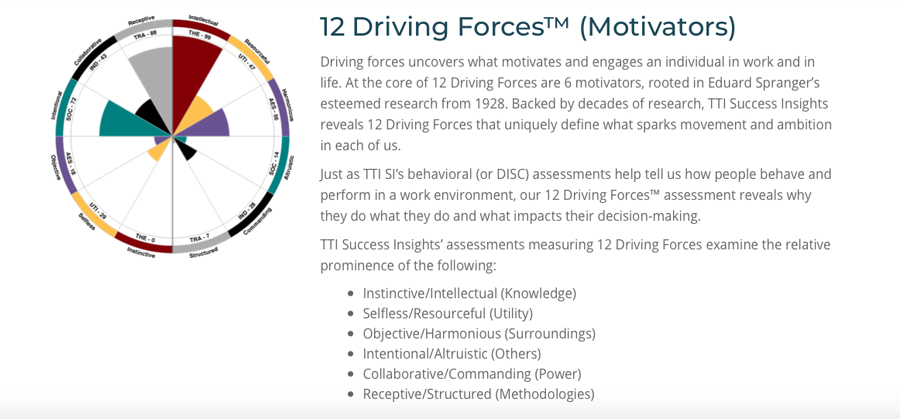
Workplace Motivators® explores the question: WHY do we move into action?
A motivator (or value) is a cluster of beliefs with a similar underlying pattern or idea that we believe to be fundamentally important. Our primary motivators help determine what gives us joy, happiness, energy and purpose — at work and in life.
Our strongest motivators provide us with a continuous source of motivation to seek out their fulfilment. They are also the source of dissatisfaction when they are violated or ignored. When it comes to business partnerships, just as it does with dating and falling in love, people can overcome basic behavioural (DISC) differences, but values are the thing that will make or break a relationship.
THE WORKPLACE MOTIVATORS REPORT
The Workplace Motivators® profile is a 14-page report. It takes you a step beyond the standard behavioural assessment to dive deeper into the world of personal values.
The 6 core Motivators measured are:
WHAT DOES WPMOT MEASURE?
Workplace Motivators® explores the question: WHY do we move into action?
A motivator (or value) is a cluster of beliefs with a similar underlying pattern or idea that we believe to be fundamentally important. Our primary motivators help determine what gives us joy, happiness, energy and purpose — at work and in life.
Our strongest motivators provide us with a continuous source of motivation to seek out their fulfilment. They are also the source of dissatisfaction when they are violated or ignored. When it comes to business partnerships, just as it does with dating and falling in love, people can overcome basic behavioural (DISC) differences, but values are the thing that will make or break a relationship.
THE WORKPLACE MOTIVATORS REPORT
The Workplace Motivators® profile is a 14-page report. It takes you a step beyond the standard behavioural assessment to dive deeper into the world of personal values.
The 6 core Motivators measured are:
 The Workplace Motivators® also includes feedback on what a person should try to avoid based on his or her motivators. TTI’s brain-based research confirms that this has a deep subconscious impact on our decision making.
VERSIONS OF THE WORKPLACE MOTIVATORS PROFILE
The Workplace Motivators® reports are available in a number of versions, each designed to support your initiatives and help you achieve your desired results. All of our tools have been designed with flexibility, practicality, and multiple uses in mind. This means you can invest once in the right profile and use it throughout the employee life cycle to maximise your investment.
There are three types of reports in the TTI Success Insights® Motivators series, including:
The Workplace Motivators® also includes feedback on what a person should try to avoid based on his or her motivators. TTI’s brain-based research confirms that this has a deep subconscious impact on our decision making.
VERSIONS OF THE WORKPLACE MOTIVATORS PROFILE
The Workplace Motivators® reports are available in a number of versions, each designed to support your initiatives and help you achieve your desired results. All of our tools have been designed with flexibility, practicality, and multiple uses in mind. This means you can invest once in the right profile and use it throughout the employee life cycle to maximise your investment.
There are three types of reports in the TTI Success Insights® Motivators series, including: