4 Reasons Why Sales Persistence Pays Off

When it comes to selling, the right amount of persistence is critical.

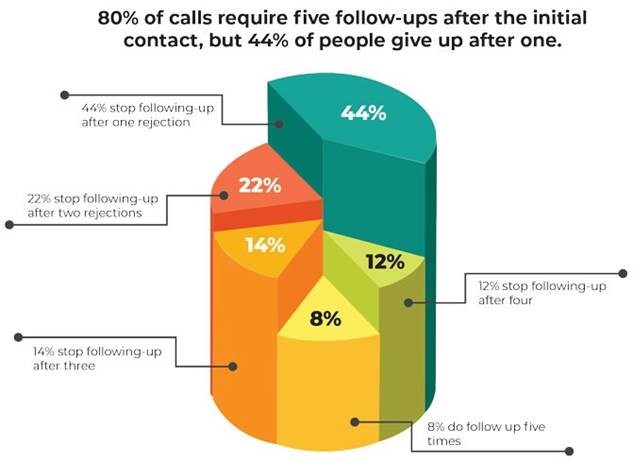
Statistics tell us – calling until you make the sale – works.

However! 90% of salespeople give up after just four calls.

This graph shows that 8% of the sales people are making 80% of the sales:

Here are 4 reasons why it is beneficial to be persistent as a salesperson.

1. It Makes You Stand Out From The Crowd

Most salespeople are not persistent.

Studies have found that almost 50% of salespeople give up after the first call.

Typically salespeople get caught up in active business, instead of following up prospective customers. Follow up your prospects with more calls than your competition, and you’re already ahead!

2. Increases Customer’s Confidence In You

Persistence will –

  • Increase the customer’s confidence in you.
  • Keep you at the top of their list when they are ready to buy.
  • Give your prospect an insight into your dedication and work ethic. However, you also need to be able to gauge when it is time to call it quits.

3. Demonstrates Dedication & Purpose

The right amount of persistence will show your prospects that you are dedicated, and truly passionate about the product or service you are offering.

Persistance assists with –

  • Building relationships, as prospective customers will see that you have purpose.
  • You can prevail through challenges.
  • It will give you a better understanding of what the customer needs.

4. Motivates You To Try Harder & Shows You The Value Of Success

Persistence helps you to discover that each failure is another learning experience. When you have a successful sale after being persistent, you quickly realise that the hard work does pay off.

The most difficult clients are the hardest to lose. Why? It takes discipline and persistence to gain their business. And 90% of salespeople don’t have it.

Sales persistence is not merely calling until you make a sale, it is knowing how to properly navigate the sales process from the beginning.

Persistence does not always come naturally, it’s a learned trait when mastered can be incredibly valuable.

Are your sales team persistent?

Contact KONA for customised Value Sales Training for your team and stay ahead of you competitors!

6 Signs Your Sales Manager Is Failing As A Sales Coach

Sales Coaching versus Sales Training - Adroit Insights

When you notice your sales team are struggling, it can be hard to pinpoint the source of the problem. Could it be that your sales manager is failing as a sales coach? If this is the case, it can lead to many problems in the business. How will you know if it is the sales manager or another factor affecting performance?

Here, we will tell you 6 signs that your sales manager could be failing as a sales coach.

6. They Are Not Motivational
Salespeople need inspiration and motivation to deliver exceptional results. There are countless ways a sales manager can motivate their team, they can offer incentives, create competitions or even verbal encouragement. If a sales manager is not motivating the team and getting them excited to sell, the team will quickly lose their drive and may even feel frustrated. 5. They Are Not Teaching Their Team About New Products A good sales manager will ensure they are setting aside time to teach their team about new products and services. If the team are not educated about a product, how will they sell it? Salespeople need to know not only what the product is, but also the benefits and features, in order to be able to sell it.
4. They Are Focusing On The Wrong Salespeople
Typically, sales managers will focus their attention on their highest and lowest performing team members, when in fact it is those in between that need the most time. Your best salespeople are already doing well and if your underperforming salespeople are consistently underperforming, this may not be the role for them. The salespeople in the middle of the spectrum can go either way. If the middle salespeople are not given the right tools and training, they will drop to the bottom. With the right coaching however, they will likely rise to the top.
3. They Are Results-Focused, Not People-Focused
If your sales manager’s only concern is successful sales and not helping the sales team, this is a problem. Sales coaching encompasses observations, uncovering strengths and weaknesses within the team and helping the team through them. A successful sales coach will focus on improving each salesperson’s performance, rather than just their mistakes.
2. They Are Not Coaching Regularly
Studies show that 65% of employees say the training and learning opportunities provided to them positively impacts their engagement in the workplace. When team members are engaged, they are more likely to take on more and ultimately become better at what they do. In order to improve skills and learn new techniques sales coaching needs to be used consistently, not just when a new salesperson joins the team.
1. Your Salespeople Do The Following:
  • Miss their KPI’s often
  • Business only comes from existing “friendly” customers or clients
  • Don’t prospect or generate enough fresh leads
  • They don’t do enough Quality Sales Activity
  • Are uncomfortable speaking with decision makers in Leadership or Senior Management positions
  • Are only comfortable talking about problems, price, and product specs
  • Miss opportunities in their Pipeline due to not chasing or revisiting leads consistently
  • Have a low Lead to Sale Conversion Ratio
  • Don’t generate enough repeat business from clients
  • Blame the market, products or services, customers, accounts, their managers, or the price of petrol when they miss target, as “It’s not my fault.”

Can you recognise any of these traits in your sales manager? If so, it may be time to consider investing in a sales coaching for your team to help them reach their full potential.

  click here to contact the KONA Group red button or call 1300 611 288  

5 Tips to Master Sales Closing Like a Pro

Closing Techniques: One Is Never Enough - SalesFuel

Sales closing is an art. A hard and elusive art.

Yet an art that when done right brings so much joy.

Well-trained salespeople have mastered the art of sales closing. But it certainly doesn’t happen overnight. Sales closing is a time-honoured skill, that with time, only gets better.

WHAT IS SALES CLOSING?

Sales closing is getting a prospect to agree to a deal and sign a contract. It is how salespeople achieve KPIs. Ultimately, it is how businesses grow revenue.

Put simply, sales closing is the culmination of all your efforts.

You put in the time and made a strong case for your customer. That is, why your product or service is the solution that will solve all their pain points.

But getting to that elusive closing stage certainly takes plenty of patience and persistence. Clients will often say no more than once before they get to a yes. However, the problem is, that many salespeople give up before they reach that final yes.

That yes that is just around the corner of Give Up Street.

19 Sales Closing Techniques for Reps (with Examples)

Now it is worth noting that sales closing isn’t the only stage of the pipeline that matters, but it is absolute. That means, you either close or you don’t.

The make-or-break nature of sales closing can make it one of the most stressful aspects of selling. However, it does not have to be. To help, here are 5 Tips to Master Sales Closing Like a Pro.

 5 Tips to Master Sales Closing Like a Pro

1. ACT ON BUYING INTENT
The Essential Guide to Successful Intent-Based Marketing

Learn how to recognise when you’ve successfully gotten your client into the buyer mindset.

That is so you know when it’s appropriate to ask for the sale. Being able to spot this buying intent during the sales process is hard. But when you learn how to identify it, you can ask at the right time and you’ll see positive results.

The buying intent could be an easy one to spot. That is it could come in the form of a straightforward expression of a desire to buy. Like “this is what we’ve been looking for! When can we get this delivered ASAP?” Or it could be a lot trickier than that. That is, more subtle and requires nudges to get over the line. Like a client taking an interest in a specific offering and asking detailed questions about it but not committing.

Either way, being able to recognise your customer’s buying intent signals the beginning of the sales closing process.

What is driving the disconnect between sales and marketing?

2. IRON OUT ALL THE DETAILS

Put everything out on the table. Clearly. That includes your expectations, payment terms, delivery details, timelines, and so forth.

Most deals fall through when each party thinks they’re getting something a little different than first agreed to. So, make sure your proposal is clear and mutually agreed upon.

3. MOVE FAST

When you get the green light, don’t stall. Otherwise, the moment will go cold.

Strike while the iron is hot. Know exactly the core steps in your sales process. Hasten to get all the administrative logistics authorised. All the while, walking your buyer through each of the steps.

No matter what you do, it is crucial not to waste a lot of time creating your proposal document.

All too often we hear from sales Managers who say their sales team hear the words they want to hear to win the deal but then take way too long to put it on paper. And very often they end up losing it to a speedier competitor. Sound familiar?

4. UNDERPROMISE AND OVERDELIVER

Even with the best intentions of creating a fantastic customer experience, sometimes businesses and their people commit to unrealistic deadlines. This, in turn, can cause them to let customers down.

So instead of overpromising and underdelivering, why not build the opposite into your business practices?  Build customer delight and loyalty by underpromising and overdelivering.

Can you create added value around the product, service, or action that you deliver?

5. ASK FOR NEXT STEPS

The best way to master sales closing like a pro is to define and agree on a clear “Next Steps” strategy

Your Next Steps strategy needs to be relevant to the sale. Such as scheduling another call to talk about quotes, visiting the prospect in person, or providing supporting documents and case studies. The point is that you need to discuss and agree on something before you end that meeting. This ensures a mutual commitment from both parties, as well as locking in another meeting.

THE PESSIMIST SAYS ½ Empty THE OPTIMIST SAYS ½ Full THE SALESPERSON SAYS “Let’s talk about the benefits of ice”

Book your Sales Team on their Value Sales Training Workshop. Gather the team and we will take care of the rest.

Call us at KONA on 1300 611 288 for a conversation, or email info@kona.com.au anytime.

LAURETTE WITH HOPE IS NOT A STRATEGY ON IT FOR KONA GROUP SALES TRAINING SALES HEALTH CHECK

3 Crucial Steps to Sales Training ROI

One of the many questions we get asked a lot, and often from sales leaders and learning and development experts, is:

How do we make sure the skills gained in the sales training are applied to drive long term results?

According to Gartner research, B2B salespeople forget 70% of the information they learn within a week of training.

And moreover, 87% will forget it within a month.

SO, HOW CAN SKILLS BE RETAINED?

The answer is not to avoid sales training altogether.

No, that would be most ridiculous and detrimental to the performance of your team.

Because in doing so you risk underskilled salespeople staying on in your organisation.

But even more damaging, is you also risk losing valuable people because they are not being developed to their full potential.

So what is the answer? How do we make sure skills gained in the sales training are applied?

Well, it’s DB-DD-MA. Define Before, Development During, Measurement After.

1. DEFINE BEFORETeams and Team Discovery - The Predictive Index

Before you embark on sales training for your team, begin by actively involving each person in their learning development.

That means defining exactly where their challenges are and how the training will benefit the growth of both them professionally and the organisation.

This is an important step because if you have not defined the expectations of your training program then how do you expect to hold your people accountable? Tell everyone who is going on the training. Clearly define outcomes.

Complete an Analysis of the Skills of Your Existing Sales Team

Next, complete an analysis of the skills of your existing sales team. Good training organisations will offer this as part of their discovery sessions.

Involve your Sales Leaders! These valuable team players are so important in making this work.

It is your sales leaders and managers who will play the biggest part in embedding the learnings from the training and making it last the long term.

2. DEVELOPMENT DURINGStages of Team Development | Introduction to Business

There are plenty of sales training techniques and sales methodologies to learn to sharpen the skills of your sales team, all the way to managers and executives.

But here are a few additional thoughts to consider during training sessions.

  • Teach your people how to give and receive feedback on the training and their learning ability
  • Get everyone to commit to the next steps, that is what they will do next with the information they have learned
  • Instill a value of note taking and instant knowledge application
  • And the biggest win! As a Sales Leader – be at the training as well. From our feedback of salespeople, nothing says ‘this isn’t that important’ to your team more than if their Leader is ‘too busy to attend. It’s also a massively missed opportunity on your behalf to see first-hand the team in a different setting to the day-to-day grind.

3. MEASUREMENT AFTER

How to Make Sense of Your Team Performance

Once training is over, have your sales managers track the follow-up commitments made by their team. Here is how.

Coaching, Coaching, and More Coaching

At the start, you defined the skills and behaviours the training was designed to impact.

Stay true to this effort and see the process through. Now is the time to double down on coaching activities around those competencies.

This is where you get the value from the training.  Set out coaching objectives based on the training for the sales leaders and their teams and make sure they adhere to it. This must be treated as a priority discussion point in your weekly meetings.

Follow-Up

Plan a follow-up internal communication campaign.

That includes highlighting areas of best practice and who’s doing well implementing their new skills.

Also, note the stories of achievement using the new learnings.

Visualise the Learnings

Part of keeping your training alive, we encourage sales managers and their teams to do a video replay of what they’ve learned.

This has proven so successful and is much more beneficial that than a ‘test’ to ensure the knowledge is embedded.

Record their learning takeaways and have their managers take note on areas they need to focus on in follow up coaching.

Additionally, make sure you maintain their active involvement in the learning process.

That means have each salesperson also include their plan in how they are implementing the new knowledge.

This embeds the learnings and is crucial for accountability.

Peer Support

Continuing from the point on active involvement, give your sales teams an opportunity to be heard.

Peer support learning is a strong way to embed and reinforce new ideas.

If a new win was influenced by what was taught in training, have the salesperson write up an internal brief using the terminology.

Share the knowledge and the rewards.

Hearts and Minds Sales Methodology Outline

Book your Sales Team on their Value Sales Training Workshop. Gather the team and we will take care of the rest.

Call us at KONA on 1300 611 288 for a conversation, or email info@kona.com.au anytime.

LAURETTE WITH HOPE IS NOT A STRATEGY ON IT FOR KONA GROUP SALES TRAINING SALES HEALTH CHECK


The Number 1 Biggest Change to Our Sales Process

Neuromarketing – How it Can Help You Grow Your Sales | Secret Entourage

4 Ways Power has Shifted to the Buyer

And What Sales Professionals Can Do to Adapt

Like so many other industries, the world of sales has shifted on its axis over the last few years. This change has indeed left many businesses and sales professionals stranded. As well as leaving many feeling quite isolated. But there is one major change that has occurred in recent years that has completely changed the way we conduct our sales process.

The biggest change to our Sales Process to date is:

The balance of power has shifted from sellers to buyers.

Let us break this down further. Over a very short space of time, our sales process has turned on its head. And as such, we must change with it or be left behind. As we have revealed, the biggest change to our sales process to date is, that the balance of power has shifted from sellers to buyers. That means our sales process has shifted from:

  • Buyer Beware To Seller Beware
  • Tangible Products To Everything-As-A-Service
  • Complex And Cumbersome To Simple And Agile
  • Product Led To Outcome Led
  • Money Now/Value Later To Value Now/Money Later
  • Become A Disruptor Strategy to Don’t Get Disrupted Strategy
What is an Inbound Marketing Funnel

The tried and tested sales skills that served us well for many years are rapidly becoming obsolete. That is because of factors like customer self-service, artificial intelligence, and as-a-service offerings increasingly become the norm.

But what does this mean to our sales process today?

Firstly, do not see this shift in the way we perform as professional salespeople as the demise of our trade. Rather, focus on exchanging old behaviours for new ones. That means re-tooling ourselves for the next sales paradigm shift. How do we do that? Here are 4 Ways Power has shifted to the Buyer and what Sales Professionals can do to Adapt.


1. BETTER INFORMED BUYERS

Online reviews, social media, and the internet has seen buyers come to you with a wealth of information. Buyers now have access to a truckload of data about your product/service and that information simply strengthens their buying power. That means before they even connect with you, buyers already know about your company, competitors, industry, and – even you.

Know More, Care More, Do More: How to Listen, Learn, and Engage with the Modern Buyer

What to Do

Update your website! Keep it fresh and informative. It is the first place your buyers will be going to seek information about your organisation. If your site is hard to navigate, appears outdated, or os not mobile friendly, you stand to lose your buyer before they even reach you. A successful website will educate your buyer and make them want to contact you.

Additionally, provide your buyer with insider-only information about your industry. Don’t waste their time regurgitating information they can simply find on another site. Rather, share features of your product or service that are not available elsewhere. While your buyer may know a lot, they simply do not know everything that you have to offer. So, with this in mind, branch out your information offerings. Consider the value of ebooks, white papers, and case studies about your industry and your brand. This will provide insider information for your buyer, and also position you as a trusted advisor.


2. END OF THE FIRST STAGE OF THE SALES PROCESS

Buyers are now bypassing the first stage of the sales process. According to a recent study HubSpot study, 38% of salespeople report that it’s more difficult to get a response from prospects than it was as recently as two or three years ago.

But why? Well, because it seems buyers are trying to answer their own questions to save time. And also to minimize contact with salespeople. You see, everyone is busier than ever. Additionally, attention spans are growing shorter by the day. But, despite how busy we all are, we continue to increase our time on social media. The average person spends approximately 2 hours a day on social channels, 60% of it done on mobile devices.

How to Build a Sales Process That Rocks the 7 Stages of the Sales Cycle

What to Do

Hang out where your buyers are hanging out. Put simply, focus on improving the quality and frequency of what you publish online.

Fundamentally, find the platform your buyers prefer and become a voice for your brand and industry.

Additionally, you can share well-researched and valuable blog posts that speak to specific points in your buyers’ journey


3. BUYERS WANT IT PERSONAL

Buyers want personalised experiences. That is, they want the customised approach from you. Moreover, they want you to understand exactly where they are in their journey. Fundamentally, they want you to already know where they are experiencing pain. And then they want a personally styled solution that’s tailor-made to their issues.

Put simply, they want empathy, not a canned pitch.

Now, are you ready for a whacky fact? The good old email still works. Buyers are more and more nowadays preferring to communicate via email than the telephone. It is done on their terms and there is a record of the correspondence to refer to later. And want some more good news? Email is a perfect platform for personalisation! Easy to tailor and great to deliver at just the right time.

7 Reasons You Need to Personalize the B2B Buyer Journey

What to Do

Make sure all your emails to your buyers are personalised. That means you will need to understand your buyer’s journey and create customised communication based on their buying behaviour. This will ensure your messaging is connecting directly to the buyer. That is, answering the exact questions they have in that stage of their journey. It’s a powerful tool to be able to deliver the right message at the right time – and you have the power to do that.

4. BUYERS WANT TO BE ROMANCED

Your buyer will always expect the red carpet treatment long after you have closed the deal. They want to continue to feel valued. And why not? Keep the relationship hot. This will ensure their return. And furthermore, it also means they are more likely to recommend you. That is, stay connected to your buyers post-closing the deal, and they will remember you next time they talk to their friends, family, and wider network about your industry offering.

Children help feed food insecure families by building and selling love-inspired yard signs | WJLA

What to Do

When you close a deal with a buyer, do everything in your power keep them wanting more. Additionally, keep the relationship alive in the downtime. That means, checking in on them from time to time with next-level email correspondence. Realise the lifetime value of your buyer. Plus, a buyer who also will be quick to provide you with positive online reviews and testimonials, which is great for repeat business!

Remember, you may not hold all the power, but you hold tremendous value as a trusted advisor and strategic partner. The power may have shifted, but there are plenty of opportunities to make a sale if you’re willing to adapt and jump onboard your buyer’s journey.

Price Is What You Pay. Value Is What You Get - Warren Buffett" Art Board Print for Sale by InvestorQuotes | Redbubble

Book your Sales Team on their Value Sales Training Workshop. Gather the team and we will take care of the rest.

Call us at KONA on 1300 611 288 for a conversation, or email info@kona.com.au anytime.

LAURETTE WITH HOPE IS NOT A STRATEGY ON IT FOR KONA GROUP SALES TRAINING SALES HEALTH CHECK


Top 5 Sales Stressors and How to Reduce Them

Being a salesperson is a stressful job. And let’s face it, many people aren’t cut out for it.

However, if you are in a sales career, you may be considering ways to reduce the stress associated with your job, as stress can negatively impact results and can prevent you from achieving success. Here are the Top 5 Sales Stressors and How to Reduce Them to help you relax and smash KPIs all in one.

1. STRESSOR: QUOTA

It’s not easy to choose the perfect sales quota that will make both management and sales reps happy. Sales targets can come to define your success or failure as a sales professional, but what can you really do to reduce the stress of these all important numbers?

Sales Quota - Meaning, Importance, Types & Example | MBA Skool

STRATEGY

Remember a sales quota doesn’t exist in isolation. The size of your target market, the mix of customers, prospects, the industry, and the product you are selling, all have an impact on your success. That said, realistic quotas need to be set to each individual. And most importantly, each salesperson must have a say in their sales target when it is being set with – not by – your sales manager.

2. STRESSOR: LACK OF CONTROL

There are so many things outside our control as sales professionals, it can sometimes seem overwhelming. That often includes factors like the sales territory you’re assigned to, or how much access you get to internal resources, or perhaps the flow of new leads.

Circle of Control: Combating a Lack of Control at Work

STRATEGY

When it comes to relinquishing the reins, it’s easier said than done. When it comes to thriving in sales, you need to be more flexible and adapt. You must welcome change and embrace the unknown. As much as we may want to control all aspects of our lives, there are plenty of things that are completely out of our control. This also applies to your sales pipeline. Recognizing what you can and can’t control helps combat stress and provides a sense of purpose.

If something is in your control, you can work at maintaining, fixing, or improving that aspect of the sales process. If it’s out of your control, work hard to move past it. Knowing what’s in your control also improves your decisiveness. That is, you can make decisions quickly and effectively because you’re better able to prioritise the things you can actually do something about.

3. STRESSOR: JOB INSECURITY

The days of the “job for life” are pretty much over. Not many people currently aged under 50 will go through their working lives with only one employer, or even just two or three. Continuous, secure employment with one organisation is increasingly difficult to find, particularly if you’re new to the job market. There are many factors that threaten job security. They include globalization, outsourcing, downsizing, recession, new technology, and most recently, a pandemic.

STRATEGY

First and foremost, you need to invest your own brand. Having a personal brand allows your prospects to build a stronger connection with you. It gives them something to connect with and also trust. Creating a personal brand is incredible way of creating positive impact on the people you meet, and a lasting one. It also gives you the opportunity of reaching your customers’ needs on a deeper, more meaningful level.

4. STRESSOR: BALANCING THE SHORT AND LONG TERM

Sales is all about, well, sales! But when the majority of your ‘worth’ at work is calculated based on last quarter’s revenue-to-quota performance, it can feel like you’re on a treadmill to constantly perform. Every quarter is important, and every quarter the quota increases. But here’s the clencher – you still have the same amount of time in a day to do the job. Balancing the short term goal with the long term goal is very hard. But done right, it is the difference between an average salesperson, and a sales superstar.

20 Objectives and Importance of Sales Quota | Convin.ai

STRATEGY

To continue being successful, month after month, as a strong salesperson you need to be consistently developing new leads for the next period. That is, while still closing sales opportunities that are happening right now. It’s a fine balancing act between short term and long term goals. That said, having a plan in place for how you will develop new opportunities and manage existing deals is critical. And it starts with having a strong pipeline management process in place.

5. STRESSOR: COMPLIANCE, ADMIN, INTERNAL POLITICS

When you first move into a sales position, you think that that the selling part is where most of the stress is. How quickly we learn otherwise! Hardened sales pros know that the real stress is the internal selling. The backend data entry. The politics and toing and froing behind the scenes.

Office Politics make BEST PEOPLE quit. | by Talha KHAN | Medium

STRATEGY

Build strong internal relationships and over-communicate with key stakeholders. Additionally, forecast as accurately as you possibly can. And where possible, stay well away from office politics. That is, in favour of time connecting with your customers.

Book your sales team on their Team Building Workshop. Gather the team and we will take care of the rest.

Call us at KONA on 1300 611 288 for a conversation, or email info@kona.com.au anytime.

LAURETTE WITH HOPE IS NOT A STRATEGY ON IT FOR KONA GROUP SALES TRAINING SALES HEALTH CHECK


Manifest success

“That Which You Manifest Is Before You.”

This is one of the most profound statements I have ever heard.

It is in one of my favourite books – The Art of Racing in the Rain by Garth Stein.

Such a simple concept, yet so true: “That which we manifest is before us”; we are the creators of our own destiny.

Be it through intention or ignorance, our successes and our failures have been brought on by none other than ourselves.

I think this is wonderful … and yet scary at the same time.

So all my successes I created?  Fabulous!  But wait a minute – if I’m not as successful as I want to be, then I created that too?  Horrors!  And my absolute failures, I created those too?  That’s a worry.

But let’s look at the positive.  We can create our own future.  It’s like The Secret. “What you think about and thank about, you bring about.” And other smart sayings: “If it’s to be, it’s up to me.” And the classic Michael Jackson line “I’m starting with the man in the mirror…take a look at yourself, and then make a change.”

We all have that potential to be M.A.D. (to make a Difference).  It starts with deciding what you want, what will make you happy, what’s important to you – and then writing it down.

So that’s Step 1: Write it down, record it, post it, tell someone about your plans.  Commit your dreams to paper (or the world-wide web) and it will become reality.

Step 2: Create stepping stones to get you over the troubled waters and to the other side – break it down into bite-sized pieces, so that you can achieve (and celebrate) small goals along the way.  Measure the steps that you are taking.  I love To-Do lists where I can tick off the things that I have accomplished each day.

Step 3: Ensure that you make your dreams ARE achievable.  After all, you DO want to be able to applaud your effort and not finding that you are depressed by every little obstacle in the river of life that may come your way.

Step 4: Is it possible to be CEO of a company that you just started with within a year?  Probably not! (Although for some Gen Y and Gen Xs that’s exactly what they want … and expect.  But that’s another conversation altogether!) Be realistic about your wants and needs.

Step 5: Put a date on your dreams.  Goals are dreams with a timeline.

Hmmm, seems like I’ve just written down S.M.A.R.T. goal-setting.  Specific, Measurable, Achievable, Realistic and Timely.

Well then, let’s start to manifest our destiny!


Top 5 Ways To Increase Repeat Business

How to Turn New Customers from 2020 into Repeat Customers in 2021 | Parkfield Commerce

It is wonderful when a client calls for another service. Or a customer places a follow-up order. Or you get that call and the customer says they’d like a repeat of what they had from you before? The warm appreciation and loyalty feelings flow through you. This is because you realise that all your hard work was worth it. And that you feel rewarded by the repeat business.

WHAT IS REPEAT BUSINESS?

Repeat business is a purchase that customers make to replace the same items or services that they had bought and consumed previously. Repeat business is the ultimate example of brand loyalty. Repeat business may also be called a “repeat sale”, “replacement sale” or “repurchase.” So, what are the Top 5 Ways To Increase Repeat Business in your organisation?  

1. GET IT RIGHT THE FIRST TIME

7 Proven Ways to Attract and Keep Repeat Customers When you make a sale to your customer for the first time, get it right! First impressions are crucial if you want them to buy from you again. And by getting it right, we don’t just mean the product or service. With every first-time customer, make sure every detail, even the minute ones, are handled as professionally as possible.
  • Ensure all correspondence is personalised! And in formal language.
  • Assign the same salesperson on your team to deal with the customer each time. That is so they can build that all-important rapport. As well as provide a clear point of contact.
Then make sure you keep your customer informed of every development throughout the sales process. If the product or service you are selling is a complex one, offer proactive advice to help the customer understand the process. And here is the clincher! One week after the product has been delivered, phone the customer to ask if they’re happy with it. Similarly for a service, follow up with a phone call to make sure everything went the way the customer expected it to, and ask for feedback.  

2. SPEND MORE ON AFTER-SALES SUPPORT

After Sales Service Industry : Good Times Are Coming This may seem straightforward and obvious, but surprisingly, for many organsisations it is not. Many businesses put all their focus and investments into pre-sale. And consequently, they do not spend any time or money on ensuring the customer is happy after they purchase from them. It is crucial to treat each communication – be it pre or post-sale – as urgent. Aim to respond on the same day the inquiry came in. If you have staff handling after-sales for you, give them clear deadlines for responses. Brief them on all your products and services, so they can give the customer accurate information about your value offerings.  

 3. RECORD ALL CUSTOMER DETAILS

Benefits of CRM software for Small & Medium-sized Enterprises Once again, this might be a given, but we have had so many organisations explain to us how it’s too hard to keep track of all their customers. And that their salespeople don’t know how to use their CRM system or navigate the software they have invested in. As a first step, teach your team to create a contact book for all their customers. It should include:
  • The name of the person they have dealt with
  • Their mobile telephone number and e-mail address
  • Full postal address details
  • A brief description of what they are requesting
  • Details of any feedback they provided
  • Any personal information you think is relevant, that is, whatever information you think will make a difference to their purchasing process in the future, make a note
 

4. PERSONALISATION ALL THE WAY

7 Proven Ways to Attract and Keep Repeat Customers Every existing customer has untold potential In a time of globalised business and instant digital connection, every existing customer has untold potential on offer. Deliver a standard customer experience This means delivering a standout customer experience is essential. One of the most powerful ways of doing this is by creating a personalised sales process and approach. Show the customer you care, this is the key factor. Personalisation is all about demonstrating you’ve taken the time to understand who the customer is as an individual and the challenges they face. And the benefits are bountiful, including:
  • Distinguishing you from the competition
  • Establishing credibility
  • Becoming a trusted advisor to customers
  • Making upselling and renewals easier
  • Creating a constant revenue stream when you increase repeat business
 

5. STAY TOP OF MIND

Top Of Mind Awareness Meaning, Importance & Example | MBA Skool The more visible you are in your industry, the more people will trust you. And consequently, the more likely you are to increase repeat business. We know that to convert potential buyers to loyal customers with increased repeat business, we must build relationships and stay in touch. And although we know we should follow-up many salespeople simply do not.

Staying top of mind with your customers doesn’t just have to be a lengthy phone call or long lunches.  There are many easy ways you can stay on your customer’s radar without too much fuss or time invested.

Remember: if you are not following up with your customer on a regular basis – your competition is! FRONT OF MIND SALES TIPS

To refine the skills of your salespeople on How to Increase Repeat Business, gather the team and we will take care of the rest.

Call us at KONA on 1300 611 288 for a conversation, or email info@kona.com.au anytime.

 LAURETTE WITH HOPE IS NOT A STRATEGY ON IT FOR KONA GROUP SALES TRAINING SALES HEALTH CHECK

Sales Performance & Sales Training

How to Boost More Revenue Through Strategic Sales Training

sales performance & sales training kona

Do you often perceive sales training as a cost-intensive event? Or that once-in-a-while opportunity where your organisation comes together to try and fix what’s broken?

Instead, what if you saw sales training as –

  • A strategic investment
  • And a proactive exercise that boosts faster and more sales?

Sales Training is a Revenue Generating Activity

If managers are able to make the connection between sales coaching and higher sales performance, then sales training becomes a revenue generating activity, not a ‘dreaded’ cost-intensive event.

Clearly, there is not one sales manager who wouldn’t then agree that sales training or coaching is crucial.

However, a recent survey carried out by Viddler revealed that 147 out of 150 sales executives agreed that “poor sales coaching” was a major weakness of most sales companies.

Another recent survey by Highspot reported that out of 79% of companies who engage in some form of strategic sales enablement process, 64% indicated ‘sales training must be improved.’

Engage in customised sales training to suit their business

Perhaps it’s time for sales managers to begin to reassess their sales enablement programs to ensure they are engaging in a more customised sales training suiting their unique business structure.

They need to take action, measure performance through good constructive feedback, and turn information into action.

Sales managers need to take action

Sales Managers should take inventory of the effectiveness and sales capability of their sales people so that the sales training can be customised to them, and not a generic ‘off the shelf’ course.

Measure performance through good constructive feedback

This can be done by assessing the gaps between where the business is right now and where you want it to be, or by benchmarking against competitors. A number of sales performance metrics can be used to measure as well as improve sales performance and grow revenue.

A few key performance metrics to focus on should include but not limited to:

  • Time spent selling, (to identify and eliminate possible sales blocks)
  • Lead response time (to ensure that your sales people are responding to leads quickly and efficiently).
  • In addition, standard size of a closed deal is also an important metric to help measure and eliminate deals that are not worth pursuing —sometimes sales people prefer to spend time pursuing small deals because they are easier to get.

Turn information into action

The ability to transform information into action that can add value to your business is the crux of business intelligence (BI). The secret to getting actions such as boosting sales, improving customer service skills, and making intelligent decisions, is having the right information.

All the information that you’ve amassed from constructive feedbacks, customer insights, sales training programs and more should be put into action.

This quote from biomedical informatics and biotechnology entrepreneur, Atul Butte, just about sums it: “Hiding within those mounds of data is knowledge that could change the life of a patient, [business] or change the world.”

KONA Group runs a series of different training programssales training, sales management training; call centre training; customer service training and more — all customised to YOUR strategy, YOUR industry, YOUR people, YOUR customers, YOUR outcomes and results.

Contact KONA Group on 1300 611 288 or email info@kona.com.au to discuss how you can improve your business results.

4 Ways to Make 2022 Your Sales Strategy G.O.A.T.

Make Your 2022 Sales Kickoff the G.O.A.T. (Greatest of All Time)

For many post the pandemic, the thought of actively selling makes their hair stand on end. The dreaded sales task, or worse, networking events, leaves the body shuddering. But pandemic or not, products and services still need to be sold. So, what are the steps to make that apprehensive sales strategy more enjoyable? And also more rewarding. That is, to ensure you get the desired outcome.

Garret Norris, CEO of the KONA Group and Sales Executive Coach, teaches businesses and sales teams how to confidently sell their products and services. Here he shares with you his top tips and 4 Must Haves in Your 2022 Sales Strategy.

Get your team onto these tips (and if you’re one of the wise ones, get them on a Sales Intensive Workshop), and learn how to calm the networking nerves. That is, learn to prospect confidently to ensure your pipeline is full all year. Have a read and get busy living the dream.

4 Must Haves in Your 2022 Sales Strategy

1. EMBED A HYBRID SALES MODEL

The good part of the past two years sent sales teams into survival mode. The attitude was typically to move our offline operations all entirely online. That is even just for the short term. And we would then all see how it pans out. However, as we know, fortune favours the brave. And for those of us who jumped into the deep end and invested in remote working options, ultimately reaped the benefits as the pandemic drew on, and on, and on.

“According to HubSpot’s 2021 Sales Enablement Report, 64% who transitioned to remote selling met or exceeded their revenue targets.”

Hybrid Sales Strategy

Now we are at the time where many are playing catch up. To stay ahead in 2022, it is now time to shape our policies and processes around a hybrid working model.

And guess what? It is not just remote leaders or salespeople who are benefitting from moving towards remote operations. The “LinkedIn State of Sales Report 2021 revealed 50% of buyers believed remote working had made the purchasing process easier too”.

Book Your Team’s Tailored 2022 Sales Strategy Workshops

2. PERSONILSATION!

Personalisation in sales pretty much means the act of tailoring your pitch so it acutely addresses the pain points, needs, and challenges of your client. That is, all while making them feel appreciated.

In other words, personalisation in sales means getting rid of generic one-liners and messages. Instead, replace them with ones that provide a more customised customer experience.

Talking Business: Predictive analytics to improve personalisation and boost sales

Among many Personalisation Techniques in his Sales Intensive Workshops, Garret suggests for higher levels of conversion, embedding some of these tips:

  • WHAT’S IN A NAME: Include your customers’ names in the subject line.
  • SPECIAL EVENTS: Send them a note on their birthday. (Keep in mind this means knowing how to create a customer profile, so you know when their birthday is. As well as those other important points you gained from your quality questioning skills!)
  • RECALL A CHAT: How did your daughter go at the championships? Did Billy get his braces?
3. KNOW YOUR WHY

According to Garret, the key to knocking the sales nerves out of your system is by having a really solid value proposition and knowing it off by heart. He adds, your reason for selling – your Why Statement – should be at the core of your sales strategy. To help craft your team’s Why Statement, Garret suggests asking yourself three questions.

  1. Why do we do what we do?
  2. What are the problems that I’m going to solve for them?
  3. How am I going to solve their problem?

Your value position is not an elevator pitch about your product or service. Rather it is the problems it solves for them. Now once you have crafted your Why Statement, make sure you know it back to front. As well as the answers to all the possible questions that could come out of it.

In Garret’s Workshops and Coaching sessions, he role-plays with his clients to go through the various scenarios and questions that a potential client might ask. He says that after doing this, clients are much more confident in pitching their product or service. As well as very keen to strike up a conversation at a networking event. They often replay these conversations as a team and share answers and insights

4. GET TECHY

It does indeed circle back to our work-from-home setup. Consider, just how much time have we spent in front of screens during the last two years? So it stands to reason that buyers too have now developed a preference for digital.

Sales Technology Landscape: Blueprint

Now, from a buyer’s perspective, that may mean relying more on live chat options. Or perhaps platforms where questions can be posed and answered on demand. But it also speaks to wider technology sales trends in 2022. Such as automation’s growing role. Or giving your salespeople more tools to drive efficiency and productivity. Keep up with the apps, software, and databases that make the selling and buying process a lot smoother for both you and your customers.

To Book Your Team’s Tailored 2022 Sales Strategy Workshops

Stay ahead of your competition by ensuring your team is sales savvy and ready for 2022. Gather the team and we will take care of the rest – learning and laughs included.

Call us at KONA on 1300 611 288 for a conversation, or email info@kona.com.au anytime.
LAURETTE WITH HOPE IS NOT A STRATEGY ON IT FOR KONA GROUP SALES TRAINING SALES HEALTH CHECK