Reasons Why Your Sales Team is Not Hitting Their Target (Infographic)

Setting a sales target is one of the most important steps for measuring the sales performance of a business.

In establishing an efficient sales team, being crystal clear about your goals keeps you growing through the years, which keeps your company on track, and drives your future success.

Hitting your Sales Target

Setting a realistic sales target is one thing, but actually hitting them is another.

Increasing competition, changing customers preferences, advancing technology, along with the strategies and tactics you implement – can all affect whether your salespeople achieve the sales goals you’ve set, or not.

Reasons Why Sales Team is Not Hitting Target - Infographic

If your sales team is having a rough time hitting their targets lately – contact KONA to discuss sales training.

Always Be Closing: 7 Strategies to Close the Sale

Closing a sale is considered the most critical step in the sales process. But as mentioned in the previous article about why your sales are dropping, many salespeople often fail at this stage, most often because they follow an ineffective sales pipeline, and because they lack the proper sales training to support their sales objectives. While closing a sale can be quite intimidating, equipping your salespeople with techniques based on deeply invested and well-researched sales plans will significantly increase their chance of closing more deals. To help you get started, we listed seven sales closing techniques that can make sure your sales wins grow more prominent on the long-term process.
  1. Summary Close – Customers like to visualize the benefits they can gain from the purchase long before they actually make a decision. By summarising the different benefits that your customer will be receiving, you are essentially giving them a clear picture of what items and guarantees will they be experiencing to use out of the deal.
  2. Question Close – This technique utilizes probing questions which can help the sales person identify if they are negotiating with a prospect or a suspect. By asking a series of probing questions such as “Am I offering a solution that can address your needs?”, you may be able to discover if that person is sold on your product, or yet, identify any potential objections that they you want to address before they make a final decision.
  3. Now or Never – Aggressive selling tactics are one of the most highly effective sales strategies wherein a sales person makes a time-bound or irresistible offer to close a sale. This technique is effective to use for customers who have not decided yet whether they should purchase or not because this shows the sense of urgency.
  4. Assumptive Close – Assumptive close, as the name implies is a technique where a sales person assumes that the prospect is going to buy the product or avail the service. The trick behind this technique is that it shows your confidence about your offering and its suitability to your customer’s unique needs. When a customer feels that they are being helped with a confident sales professional that understands them, they are more likely to show resistance and follow the lead of that sales professional.
  5. Extra Incentive – Closing a deal is sometimes a matter of giving additional incentives to your potential customers. A free trial or complimentary service will not only give the customer a sense of urgency to avail the free offer when it is near its expiration, but it will also help you gain more leads as people love to receive free items from their purchase – regardless of the product or service it is.
  6. Take Away Close – This particular sales technique adapts to the psychological practice on how children are attached to toys to purchase, but, parents disapprove to be bought. In this technique, a significant feature of the product or service is removed in exchange for a discounted price. By doing so, the customer will think if the discount is really worth getting for that special feature they will be choose not to avail.
  7. Opinion/Suggestion Close – When you’re in the closing stages of a sale, one challenge you might encounter is conveying to your client the value of your product or service. The ability to gauge their interest by showing your personal preference and opinion about the item will ensure trust and good sales interaction and purchase to customers.
Contact KONA Customised Training and Consulting today to let your sales team be trained and exposed to different effective strategies to close the sale.

Brand Positioning: Selecting a Point of Difference (Infographic)

Some marketers only focus on searching more leads and creating different strategic advertisements in order to increase their sales. While these activities are indeed critical, both would be pointless if your target market does not see any point of difference between your brand and your competitors.Brand Positioning Selecting a Point of Difference

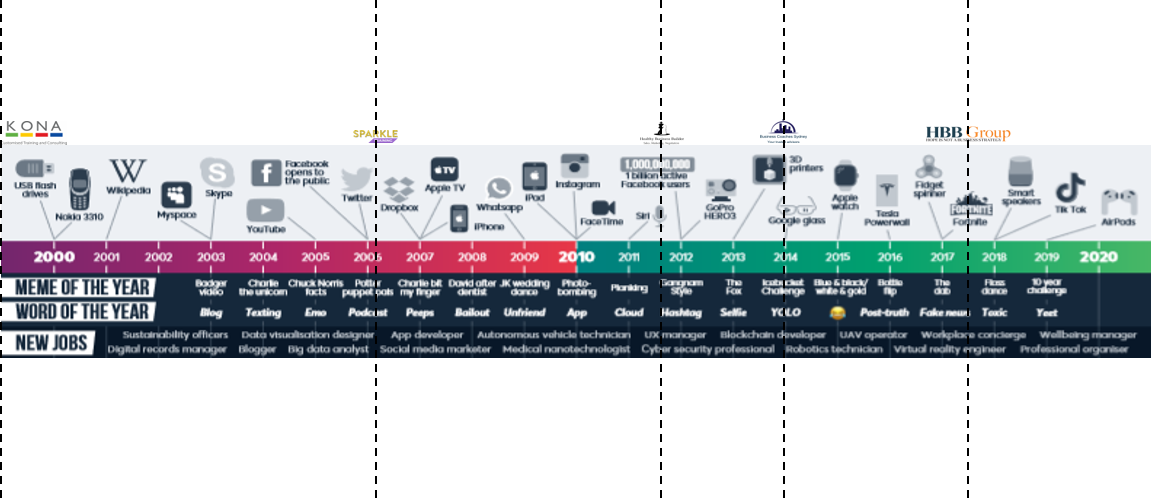
KONA Says Thanks | Celebrating 20 Years of Success!


WHAT HAS UNRAVELLED OVER THE LAST TWO DECADES?


This month KONA is celebrating 20 years of gratitude.

During our company’s time of growth and success, many events have unfolded.

Here is a snippet of the last 20 years in the workforce:

     
2000 1 July Howard Government introduces a Goods and Services Tax
15 September – 1 October 27th Summer Olympic Games held in Sydney.

Year Date Event
2001 Australia celebrates centenary of federation.
25 February Death of Donald Bradman aged 92 in Kensington Park, Adelaide, South Australia.
Western Australia adopts a uniform Age of consent of 16.
Boat load of asylum seekers is rescued by Norwegian ship, leading to the Tampa affair.
Australian forces deployed to War to topple Taliban for supporting Al-Qaeda
10 November 2001 Australian federal election: John Howard is reelected as Prime Minister.
2002 12 October 2002 Bali bombings, the deadliest act of terrorism in the history of Indonesia, killing 202 people (including 88 Australians).
2003 Australian military deployed to Iraq War to oust the Saddam Hussein regime for serial non-compliance with the 1991 Gulf War Peace Treaty.
Northern Territory introduces uniform Age of consent set at 16 for everyone.
New South Wales becomes the last State to have a Uniform Age of Consent at 16 for everyone.
Australia hosts the Rugby World Cup, with the home side losing the final to England.
19 September Slim Dusty, Country Music Singer and Musician Dies aged 76.
2004 9 September bomb explodes outside the Australian embassy in Jakarta, Indonesia.
9 October 2004 Australian federal electionHoward Government (LiberalNational Coalition) wins fourth term and defeats Mark Latham led Australian Labor Party.
2005 December Sydney beachside suburb of Cronulla sees a protest against the alleged bashing of a beach lifeguard, developing into an alcohol-fuelled, racially charged riot.
2006 15–26 March The Commonwealth Games are held in Melbourne.
8 September Death of Peter Brock, aged 61
Australian Forces are again deployed to East Timor to help stabilize the country.
2007 Australia avoids recession amidst Global Financial Crisis (to 2010)
24 November 2007 Australian federal electionKevin Rudd (Australian Labor Party) defeats John Howard (LiberalNational Coalition) to become the 26th Prime Minister of Australia.
2008 22 January Heath Ledger Dies from an accidental prescription drug intoxication.
2008 13 February Kevin Rudd leads bi-partisan Parliamentary to formally apologise for the Stolen Generations.
Longest heatwave for an Australian capital city recorded in Adelaide.
15–20 July Sydney hosts Catholic World Youth Day
5 September Quentin Bryce assumed office as Governor-General of Australia, becoming the first female to do so.
2009 7 February – 14 March Black Saturday bushfires: Massive bushfires swept across Victoria, resulting in 173 fatalities.
2010 23–24 June Julia Gillard challenged and replaced Kevin Rudd as leader of the Labor Party to become the 27th and first female Prime Minister of Australia.
17 October Mary MacKillop canonised as Australia’s first Saint of the Roman Catholic Church.
21 August 2010 Australian federal election: Election results in hung Parliament and narrow victory by Julia Gillard (ALP) over Tony Abbott (Lib-Nat Coalition); Liberal Ken Wyatt becomes the first Aboriginal elected to the Australian House of Representatives
2011 Queensland is affected by major flooding followed by Cyclone Yasi.
2012 1 July Carbon price introduced by the Gillard Government.
2013 21 March Julia Gillard apologises to victims of forced adoption practices for removal of babies from predominantly young single mothers
26 June Kevin Rudd defeats Julia Gillard in a leadership spill, 57 votes to 45. Gillard resigns from parliament, Rudd is sworn in as prime minister.
7 September 2013 Australian federal election: Tony Abbott defeats Kevin Rudd to become the 28th Prime Minister of Australia.
2014 14 July Carbon price is dropped by the Abbott Government.
21 October Death of Gough Whitlam, 21st Prime Minister of Australia.
15–16 December 2014 Sydney hostage crisis
2015 20 March Death of Malcolm Fraser, 22nd Prime Minister of Australia.
15 September Malcolm Turnbull defeats Tony Abbott to become the 29th Prime Minister of Australia.
The Matagurup Refugee Camp is founded in Perth to defend Aboriginal Rights
2016 2 July 2016 Australian federal election: Malcolm Turnbull remains as Prime Minister of Australia.
2017 Late July John Cameron sets off the chain of events that became the 2017 Australian parliamentary eligibility crisis.
9 December Same-sex marriage is legalised by the Marriage Amendment (Definition and Religious Freedoms) Act 2017.
2018 24th August Scott Morrison succeeds Malcom Turnbull as Australian prime minister.
2019 16th May Former Prime Minister Bob Hawke dies aged 89.
(source: https://en.wikipedia.org/wiki/Timeline_of_Australian_history) On the verge of all the changes, along the way Kona Group has always maintained its goal for its clients:
  • Doubled sales of a B2B sales force in 6 months
  • Increased revenue of Finance organisation by 20%
  • Increased sales of a Pharmaceutical client by 19% to achieve 140% of annual target
  • Increased revenue for a Distribution client by 17%
  • Increased customer retention of a Major Credit Card by over 12%
  • Trained a sales team to make 439 appointments in ONE POWER HOUR Sales Training workshop and another team to sell over $1,200,000 of excess stock in another HOUR
  • Helped raise over $1,300,000 for Charity
  • Grown KONA from a one-man band to a team that is now part of the HBB Group with a team in excess of 18 Consultants Worldwide
With Training and Coaching Specialists in Sydney, Melbourne, Brisbane, Singapore and Auckland, the KONA Group provides Customised Training programs that include:  Sales Training & Coaching, Sales Pipeline Training, Key Account Management Training, Call Centre Training & Coaching, Negotiation Skills Training & Coaching, Motivational Speakers, Storytelling For Sales, HR Consulting; DISC and MBTI, and more.

So, from our first client Fairfax back in 2000, to all of our past, present and future clients we THANK YOU all for your ongoing support and trust, as we really do appreciate it.

If you are looking to increase the effectiveness and results of your organisation, contact:

KONA Group

1300 611 288

info@kona.com.au | www.KONA.com.au

to discuss how we can help you to improve your organisation’s results.

Because Hope Is Not A Sales Strategy

Your Team Customised to Your Industry  

7 Reasons Why Your Sales Are Dropping

Is your business experiencing a drop in sales?

Sales promotions are one of the reasons why businesses operate and acquire more leads.

But while the term sounds easy on the ears, sales promotions actually involve a high level of strategy and psychology that even the most prominent brands sometimes get wrong.

Salespeople are always creating a better plan comparing different statistics with the previous results of operations, but at times, this amount of data is not enough to situate an appropriate sales plan for a specific target.

Every salesperson fears to drop their sales because of factors that make their plans and strategy lack.

In the specific occurrence of events, we cannot control everything, let alone change itself. However, learning how to develop and adapt backup plans is effective when things go wrong with your sales.

There are a lot of factors that affect sales dropping in your business; this varies from hiring employees that have no proper training, missed competitor campaigns, the unclear input of internal and external sales, etc. But, the real question is, why does your business experience a sales drop?

Ineffective Sales Pipeline Management

Managing your sales pipeline starts with estimating incoming cash flow by looking at the analytics for existing leads and sales opportunities.

Yet, some brands fail to use useful analytics to track key metrics on how successful deals take place and how the overall pipeline growth takes place. I

Ineffective sales pipeline management can lead you to miss leads that are nearly closing to a sale, or pursue suspects that neither need your solution nor fit for your business.

Unclear Communication

Some people only listen with the intention to hear, but not with the purpose of understanding.

It is essential to have a productive relationship between different teams that handle sales to make a strategic plan to maximise sales performance.

But at times, some teams cannot show cohesiveness, resulting to a loss of sales, and being unprepared for advertising campaigns.

Lack of Sales Follow-up

Every lead that you will get during sales campaigns should be followed-up as they move through the sales pipeline.

Some companies forget to check with their leads because of the different considerations when campaigns started, but this is not a reason why you should not check yours.

According to a research, lack of sales follow-up can be costly – upwards of 10% more in revenue lost per year.

Ineffective Forecasting

Some sales representatives are too pressured with the sales drop that their campaign had experienced, and this results in changing and guessing the real data between your wins and losses.

It is best to use historical data and the right metrics to extrapolate the results of your quarterly outputs; being truthful with every detail that is enclosed with your report will give your company more accurate insight on how to adjust and create more strategic plans.

Overlooking Competition

When it comes to handling sales properly, no one is ever entitled to be comfortable, just because their leads are increasing.

Being competitive with your sales shows how dedicated and advanced your company is when it comes to performing the right strategy and plan for your consumers.

Competing brands are also stepping up their game by doing thorough research about their consumers and how they can market their brand while adapting to different trends.

If you’re not aware of what your major competitors are doing, you’re flying blind.

Look to see whether your competitors have seen an increase in sales, while you’re experiencing a decrease.

Insufficient Sales Training

The salespeople that are aware of their clients’ strategies will better focus their sales efforts; this includes DNA-ing the client.

Companies who intend to survive for the long haul should invest in sales coaching that will further improve their competency in attracting new customers and closing more leads.

Lack of Motivation

Incentives and rewards are effective motivational tools that many companies still do not use to boost their sales performance.

Motivation creates a healthy environment which then creates good outcomes resulting in the sales increase. Do not take for granted the hardships of your salespeople; it is best to practice fair treatment in every win that every person acquires for the company.

KONA Group

1300 611 288

To discuss how we can help you to improve your organisation’s results.


How to Sell Value Instead of Price

Customers are willing to pay more for products and services that guarantees them significant value. Most companies, at times, are presenting their products right away without even knowing if they are really engaging with their customers.

One might say that every product is just the same as the other, and it only differs with its price range; but, have you thought about how buyers also have different needs and points of view towards products?

How to Sell Value Instead of Price - Infographic

Author – Garret Norris – https://www.linkedin.com/in/garretnorris/

Top Sales Trends in 2018

Q4 has already started, and this means that we are only a few months away from 2019. Some of our clients have created a full sales strategy for this year, however different positive and negative implications have already taken place and key lessons learned – which is why businesses should adapt to the everchanging consumer purchasing habits and develop new techniques to be effective. For salespeople, it is important to blend in with the different trends that resonates with customers. Trends depicts how products and services should move and innovate because the sole reason why these are created is for the consumer’s benefit. Given that most companies are using technology to acquire further knowledge about buyer behaviours and the future of sales roles, there is no doubt that sales trends are also advancing with the use of automation programs. In this article, we will look at the different sales trends in 2018. Here are common business strategies:
  1. The Personalisation of Sales – One of the top sales trends this 2018 is personalisation. According to Accenture’s personalisation pulse check this 2018, about 2 in 3 consumers are more likely to purchase from a retailer if it sends them promotions that are relevant and personalised. Since the digital age has a huge impact when it comes to making a natural marketing communication through consumers, businesses can easily create humanise content for consumers using modern technology to convey goals.
  2. Using Artificial Intelligence and Automation for Sales – AI and automation saves the staff time when it comes to collecting data, which means less time answering calls and more time on more essential tasks and initiatives such developing new selling techniques, conducting sales performance analysis, and sales coaching to client-facing employees.
  3. Structured Sales Influenced by Millennials – Companies today are hiring more and more Millennial people. Marketers who succeed in handling their sales will proactively assess the impact millennials may have on their market from a macroeconomic perspective and as social influencers, which could affect bottom line campaign results.
  4. A Call for More Efficient Leads Management – More advanced sales and leads platforms are created to enable companies respond to every potential customer’s concerns as quickly as possible. However, many businesses are yet to fully realise the potential of these solutions in their sales operations. In fact, a recent Harvard Business Review study revealed that a large portion of companies are slow to respond to their potential customers; 24% of 2,241 U.S companies took more than 24 hours, and 23% of companies never responded at all.
  5. Account-Based Sales Leveraging Content – Companies are bringing together sales and marketing leaders to create a cohesive strategy to grow key accounts. And in 2018, creating content with the purpose to adapt to the natural behaviour of your consumers and heavily engage on building trust between business to community relationships. In this way, companies’ sales and marketing teams can design a successful campaign by tailoring content to specific consumers along the buyer’s journey.
This sales trend is focused on how buyers’ behaviours are changing with the rise of digital engagement and purchasing decisions, and the impact this is having on sales roles across both B2B (business-to-business) and B2C (business-to-consumer) channels. If you are looking for a remedy to enable your company to create more sales and leads, KONA can offer you sales training. Contact us today to learn more Sales Management Training program can benefit your business today.

Reasons Why Customers Are More Important than Price (Infographic)

Price and value are different definitions of how customers react to a product’s purpose. Price talks about the scale of the worth of a product or service by labelling the amount that customers will pay. On the other hand, value discusses the unique propositions of the product, which will enable customers to know more about the usefulness of their purchase. For example, some products have particular storage consumption which is indicated on the packaging of the product; it may be for 24 months or 12 months which suggests the quality that is prescribed when use. Most products and services ensure quality performance by ranging their prices through what the customers can afford. But not all consumers are checking prices based on the trend; customers sometimes look into the value of a product and what it can step up for them when they use it. Reasons Why Customers Are More Important than Price

When Does the Sale Stop and the Negotiation Begin? (Infographic)

Sales equate the well-being of a company, it manages the income and expenses of a business and can cover its costs to create a stable operation. This also builds a healthy relationship with potential clients and investors since the data included on sales reports will provide sufficient knowledge to the company’s credibility. Without sales, one cannot interpret the current status of the company’s operations, increase the overall impact to customers, and provide the necessary growth for the business. When Does the Sale Stop and the Negotiation Begin?

How to Ask Powerful Sales Question to Uncover Buyer Needs (Infographic)

Asking effective and probing sales questions is critical to uncover buyer needs. These questions often depend on several factors such as the level of competition in your industry, as well as the value your products and services provide to your customers.

By asking the right sales questions, you will be able to understand the nuances behind the different behaviours and needs of your customers. Powerful sales questions are the root of how you can prove your brand’s long-term relationship to your customers.

In this article, we will discuss the different techniques and tips on how to formulate powerful sales questions to uncover buyer needs, but first, let’s define the importance of “the art of questioning” in sales.

How to Ask Powerful Sales Question to Uncover Buyer Needs