TRAINING DOESN’T WORK

An astonishing 85% of sales training falls short of delivering on its ROI. Additionally, approximately 80% of new skills are lost within one week of training if they are not used, and about 87% of skills are lost within a month of training if they are not used regularly.  Sales is the lifeblood of a company. Therefore, without steady sales, companies fail. Yet, some sales teams receive little, if any, training. Others receive inadequate one-hour seminars and are told they have just completed sales training. Is it any wonder why sales training doesn’t work?  The best salespeople in the world are akin to Olympic-level athletes. However, companies treat them as if they can simply hit the ground running and sell, sell, sell without any training at all. Consider how many hours go into training for the Olympics. Ultimately, an Olympic gymnast trains for years before hitting the mat with her teammates. So, we should do no less for our sales leaders! There are many reasons why sales training doesn’t work. The right sales training techniques, however, can help your sales team train for their own unique “Sales Olympics.” 

Sales Training Not Working? Here are Five Reasons Why Your Training Fails

A typical sales training scenario is a one-day, half-day or even shorter training session. That involves, an expert, consultant or high-producing salesperson to be invited into a company to speak to their sales team. The expert may hand out books or binders, encourage team members to participate in team-building exercises and listen to plenty of motivational speeches.  After a day of receiving exhaustive knowledge on communications, persuasion, prospecting and follow-up, the sales team is told they have successfully completed training. They return to their regular work the following day, and soon the old habits return.

There are many reasons why some sales training sessions fail and others succeed.  
Here are five common reasons why sales training often fails. 
1. Activities are not tailored to adults.  Considering the typical sales training model, it is unsurprising that companies fail to achieve their training ROI. KONA Group CEO Garret Norris, an expert in adult education, identified several key factors for best practices for adult learning. Adults need training that speaks to their learning needs, not training modelled after typical university classroom practices.

KONA Group CEO Garret Norris on Why Training Does Not Work

Adults engaged in learning activities need to: 
  • Know why they are participating in an activity.
  • Feel invested in the outcome — “What’s in this for me?”
  • Learn through doing. Newly learned activities must be practised to become second-nature. 
  • Solve problems. Solving problems helps place a new activity into an adult’s long-term memory.
  • Learn in a social setting. Adults, even more than children, prefer to learn while among peers.
  • Tap into their life experience. That is, so they forge connections between what they have just learned and real-life scenarios and situations they remember.
  • Integrate new knowledge with existing information. They like to see a connection between what they have just learned with things they have previously learned.

Assuming adults who attend a one-day seminar will become exceptional salespeople the following day is an unreasonable expectation. Sales training issues aren’t problems with salespeople — they are problems with the model used to train adult learners, whose needs remain unmet by lecture-style workshops. 
2. Not enough time allowed for results.
Another factor often overlooked in why sales training doesn’t work is leadership. Companies may invest in sales training, but if the company’s leadership team doesn’t support the time required to learn new skills, sales training may fail.  Companies often seek immediate ROI for investing in sales training, but as we have seen, this is an unrealistic expectation. Failing to give the participants enough time to learn, practice and perfect new skills is like asking an out-of-shape adult to run a 10K next week — you can ask, but the person is likely to fail (never mind get hurt!).  To truly enact a culture of continuous learning in your organisation, you must “put your money where your mouth is” and pay more than lip service to sales training. Corporate leaders must be willing to allow salespeople to attend training. They must be patient while new skills are learned. Systems must be set up to monitor, measure and report on sales results, with the data used not to punish low performance, but instead to coach and train for improvement.
3. Lack of leadership buy-in and participation.
Can you imagine a NRL team coach who never attends practice? Or the captain of the AFL team telling his players he’s too busy practising his surfing to attend team practice? The same thing happens with many sales managers: they assign personnel to training without attending training themselves.  When sales managers fail to attend training, it leads to a big disconnect between “Do as I say” and “Do as I do.” They give mixed messages about the importance of training. Perhaps more importantly, they cannot model the appropriate behaviours because they haven’t learned alongside their staff what’s important. 

Managers must be willing to commit the time and effort to sales training alongside their team members. Actively participating in sales training not only encourages team members but demonstrates support for the key concepts being taught. Whether it’s participating in classroom activities alongside trainees or role playing along with them, when the manager participates, training is more effective. 
4. Start With the End in Sight: Set Goals 
The first step to creating an ideal sales training model is to begin with the end goal in mind. Establish key goals, metrics and measurements first, before creating your training. 

Identify what you would like the sales team to learn, know and do after the training is completed. The goals for product knowledge sales training may be quite different from the goals for sales skills training. Identifying which skills to focus on first, and the desired outcomes, will have the most impact.  Additionally, practising in a safe, supportive training environment takes much of the risk out of trying new activities. A supportive and encouraging coach ensures people know when they have demonstrated a new skill successfully.

To GET YOUR TEAM INVOLVED IN ACTIVE LEARNING AND ENGAGED IN THE ART OF SALES contact 

KONA 1300 611 288 | info@kona.com.au for a confidential conversation today.

A Sales Manager’s Guide for Underperforming Sales Teams

HOW TO TURN AROUND UNDERPERFORMING SALES TEAMS THAT  ARE STRUGGLING DURING THESE COVID TIMES

It is 8.30 in the morning. You walk into your office alone as your team must work from home, coffee in hand. You wish you could hear the chattering and bustle of your team. You enter the room and look around.

Phones are not ringing, and fingertips are not dancing across the keyboards. You long to hear the excitement in the voices of your team members. You miss the energy that was electrifying.

You think, do we have an underperforming sales team or what is going on? Then the mood shifts.

Someone calls you on MS Teams, when you answer you see one of your team spinning around in their chair, accordingly she winks and says, “That’s $5,000 before noon, Boss.” Normally the cheering in the office would be truly equal that of a crowd at an AFL final.

You quickly get your mojo, even manage a smile and say, “this is going to be a good day, I can feel it in my waters”.

*Beep beep beep* 

Then finally comes your rude awakening. The sound of your alarm every morning is brutal. In fact you dream of a pre COVID sales team that’s crushing their quotas on a daily basis and a team culture that’s both supportive and competitive.

However that is not the case. They are struggling every day. They are also not closing deals. Similarly, they do not even seem to know how to qualify leads in this environment, truth be told… nor do you. Revenue is down and quite frankly – you are in trouble.

The good news? Your dream is not far off.

HERE IS A GUIDE ON HOW TO TURN AN UNDERPERFORMING SALES TEAM AROUND

Firstly, start from the beginning: Where did things go wrong? Yes, you can “blame” COVID and no one would flinch if you did. Many sales managers tend to have the kind of reflexive thinking that ends up making the problem worse. Why? They never figured out what caused all these issues in the first place. Let’s take a look at how you can get there.

TURN YOUR UNDERPERFORMING SALES TEAM AROUND contact the KONA Group | 1300 611 288 | info@kona.com.au

GETTING TO THE ROOT CAUSE OF THE PROBLEM

Often when things go wrong, we seek to blame rather than to solve. Have you ever had a conversation with a child, and they kept asking you “Why?” Regardless of your response, their next question was always “Why?” It is likely that you ended the conversation with a firm, and for the child very unsatisfying, “because.”

Well, guess what? While this is an excellent way for a child to drive their parents crazy, it’s also the same approach that turned Toyota into a $500 billion company. The company pioneered a problem-solving methodology for an underperforming sales issue, known as the 5 Whys Model. Let us take a look.

THE 5 WHYS MODEL

The 5 Whys Model has been praised by the start-up community as the quickest way to identify the root cause of a problem. We are going to take a look at how it works, the limitations to the model and what you can do to improve it.

So how does it work? You simply begin with a statement of the problem, that is,  “I have an underperforming sales team.” Next, you ask “Why?” and you continue to ask “Why?” in response to each statement until you have arrived at what’s actually causing the problem. Here is what the conversation could look like.

TURN YOUR UNDERPERFORMING SALES TEAM AROUND contact the KONA Group | 1300 611 288 | info@kona.com.au

Sales Manager: I have an underperforming sales team.

You: Why is your team underperforming?

Sales Manager: Nobody seems to be giving their best.

You: Why are they not giving it their best effort?

Sales Manager: They’re not personally invested in their success. They say they want to come into an office, do the day-to-day work, and leave at 5 p.m. sharp.

You: Why are they not personally invested?

Sales Manager: I think it is because we only reward the top sales rep, and everyone sees the top position as out of their reach. Only Glenn, the top guy, is killing it and the rest are not hitting target as they cant travel.

You: Why do they think the top position is out of their reach?

Sales Manager: Because Glenn has been the top rep ever since he started and they’ve pretty much given up on trying to even compete with him.

You: Why have they given up on trying to compete with him?

Sales Manager: Well, he is better than everyone by a long shot and still is.

Aha! In this situation, you have discovered – in less than two minutes – that your reps are not motivated to perform as well as your top performer. Voila – the reason for your underperforming sales team is now known.

LIMITATIONS TO THE 5 WHYS

While the 5 Whys approach can be a powerful problem-solving technique, it comes with limitations.

  1. Single cause issue. It assumes that there is only one cause behind the effect.
  2. Deductive thinking. Often, problem solving does not take place where the problem occurred. This leads to the discussion not being grounded in what actually happened.
  3. Confirmation bias. The person asking the questions will jump to conclusions because they’ve “seen this happen before”.

Here are four simple ways to improve your use of the 5 Whys Model and turn your underperforming sales team around:

  • Use a timeline. Identify the events that detail how the problem occurred, outside of COVID.
  • “Go and See.” Observe what is actually happening, rather than make assumptions as to what might be happening.
  • Gather data. Demonstrate that the answer to any of the whys is plausible.
  • Ask again. For each of the causes your sales reps come up with, ask them another five whys.

A STARTING POINT

Despite its limitations, using the 5 Whys Model offers you a great way to explore the potential issue at hand and opens up the lines of communication. It will assist you in challenging your assumptions and identify the areas in which the issue lies. And once you have done this, you can start looking at solutions to the problem.

Next, let us take a look at the three most common causes of an underperforming sales team and how you and your sales team can get out of a rut.

1. DID YOU HIRE THE RIGHT SALESPEOPLE?

Good sales managers ask themselves this question constantly when faced with an underperforming sales team. But it is not just about deals closed or leads qualified – it is about your team working together. It is about your sales culture. To illustrate this, let us look at an example.

The LA SWAT team used to be a volunteer task force within the LAPD that took on the most dangerous missions. These volunteers were skilled at combat, and many of them had unique experiences, such as the Vietnam War. But because they were not a cohesive team, the early SWAT teams suffered from sky-high mortality rates.

Members of the SWAT team face life and death situations every day. For them, having the right people is not just important. It is the difference between waking up the next day and knowing that your teammates will too.

Today, the SWAT team no longer consists of volunteers. Each candidate has to go through a six-day selection process during which they need to meet mental as well as physical criteria.

THE APPROACH

One of the most challenging tests is called “Hogan’s Alley.” This is a mock street scene where candidates are confronted with surprise situations in which they need to make life or death decisions. This includes whether or not to shoot a suspect or deciding whether a person is a friend or an enemy. During these tests, candidates need to demonstrate that they can think clearly and make a decision while they are exhausted, and even physically hurt.

While this is an extreme example, it is an approach to hiring that can be applied to any team. In order to not just survive, but to thrive as a business, you need to make sure you have the right people onboard.

You don’t want just good sales reps, you want sales reps who are cultural fits to work for your company. Plan and map out your desired skill sets and behaviour traits and use them as a guide in your hiring process. You’ll find that your existing employees fall into three camps.

TURN YOUR UNDERPERFORMING SALES TEAM AROUND contact the KONA Group | 1300 611 288 | info@kona.com.au

GREAT SALES REPS, GREAT FITS

They are not just your money makers – they are the future of your company. Incentivise them to stick around. Put them in leadership positions, get them talking to your most important prospects and help them reach their career goals.

GREAT SALES REPS, BAD FITS

These are people who are great sales reps, but they are in the wrong place. Maybe they do not believe in your product, or they are better suited selling to a different type of customer.

BAD SALES REPS

The killer instinct does not come naturally to the majority of people. This is something that cannot be taught. No amount of intellect or positive attitude can make up for it. Cut your losses quickly by letting go of sales reps that are either in the wrong business or the wrong career as soon as possible.

While firing people is never easy, you are doing both them and yourself a disservice by keeping them around. If you have mapped them and maximised the key skills and they still do not perform, then you need to be a strong leader.

TURN YOUR UNDERPERFORMING SALES TEAM AROUND contact the KONA Group | 1300 611 288 | info@kona.com.au

2. IS THERE A STRONG TEAM CULTURE?

The tech community loves to say that culture is something that happens “organically.” As XPLANE founder Dave Gray points out, this doesn’t mean we should just sit back and wait for it to happen. It will not as HOPE IS NOT A SALES STRATEGY!

As a sales manager, it is your job to keep a finger on the pulse of the culture and provide support.

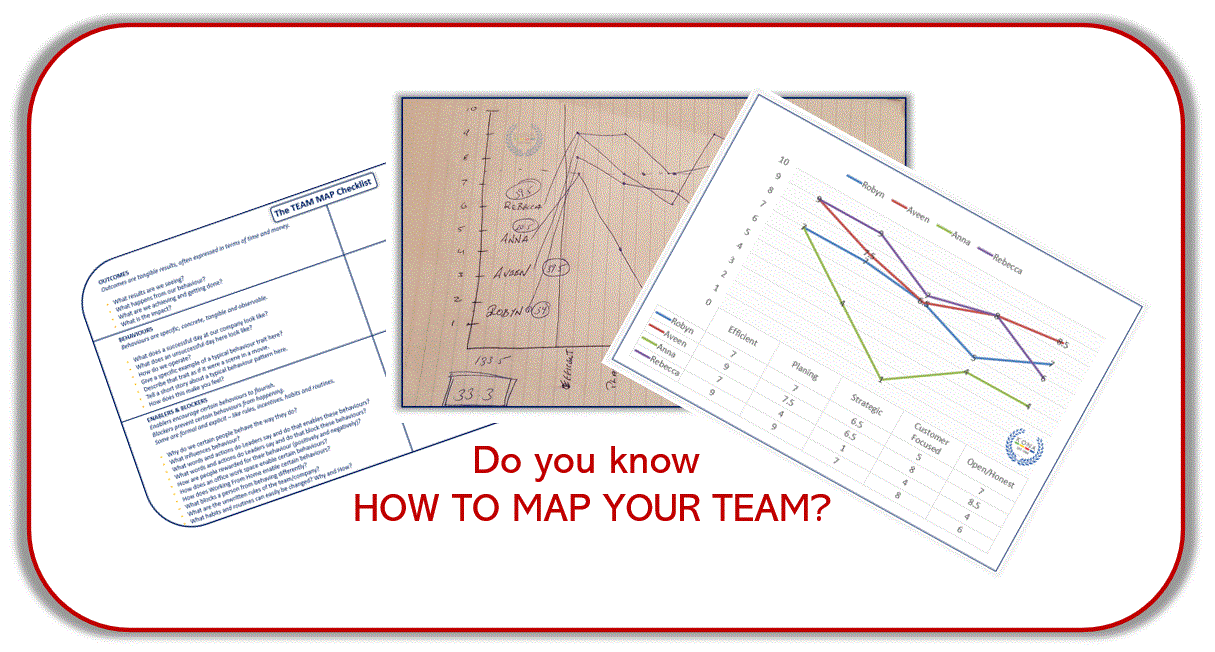
Create a road map for your sales culture using mapping techniques.

Below are the key elements to focus on.

Outcomes. These are the objectives that you want your culture to achieve. It can be that your staff loves coming into work or that all your employees perform at their best.

Behaviours. Look at how individual behaviours influence the team and their ability to achieve your desired outcome. Reward encouragement and teamwork, but reprimand behaviours that bring down morale. If there is a toxic person on the team, get rid of him or her ASAP.

Enablers and Blockers. Check to see whether you have tools and people who make the job easier and more efficient, or if you have tools and people who inhibit people from doing their jobs well.

TURN YOUR UNDERPERFORMING SALES TEAM AROUND contact the KONA Group | 1300 611 288 | info@kona.com.au

3. ARE YOUR SALESPEOPLE MOTIVATED?

Firstly – hustle. That is what great salespeople are all about. And no salesperson is going to hustle when the compensation is not worth the work they put in.

But compensation is not just about the money. It’s about how you value a rep’s hard work and incentivise them to do better.

However, one of the most common causes of an unmotivated sales team is a complex compensation plan. Harvard Business School’s Dr. Doug J. Chung spent half a lifetime researching motivation and sales compensation plans. And the result? Well, it does not take a Harvard degree to grasp where things can go wrong. Chung found that there were three main factors to consider when designing your compensation plan.

COMPENSATION PLAN

  1. Salary v Compensation. This depends on the reliability of your industry’s sales cycle. If you are in a seasonal sales business, you can’t reward reps for blind luck. If sales do not fluctuate based on these outside factors, compensation should be directly tied to performance.
  2. Timing. The influence timing has on reps directly correlates to how naturally motivated they are. Similar to great students, great reps just need a year-end bonus to motivate them, but middle-road and low performers need more frequent benchmarks to keep them on track.
  3. Ratcheting. Many companies increase sales quotas of top performers year-to-year to get them to strive higher and higher. Chung’s studies indicated that this is actually detrimental to morale. This means that top performers are penalised for succeeding rather than rewarded. An alternative is to give over-achievement bonuses, where yearly benchmarks stay the same, but hitting an even loftier goal is rewarded with more.

It is simple: When salespeople do not know what they’re getting for the work they put in, they’re going to be less motivated. Structure and tailor your compensation plan in a way so that it incentivises each type of sales rep on your team to improve and get better –one plan does not fit all.

DRIVE YOUR SALES TEAM TO CONTINUOUSLY IMPROVE

Sales teams do not become great overnight. They become great because they work at it continuously. This is why your role as the sales manager is crucial. It is your job to help your sales team succeed. It begins and ends with you.

ACCEPT RESPONSIBILITY

Swedish economist Tobias Fredberg found a fascinating pattern by examining how dozens of CEOs spoke in interview transcripts. CEOs who had successfully turned a company around shared the same way of speaking. They personally took the blame for problems—using the words “I” and “me”—and passed the credit to the team for successes—using the words “us” and “we”.

As the sales manager, you are responsible for your team. When stuff goes wrong, it is up to you to step up to the plate and be accountable for your own actions. That is what being a good leader means—and that’s what will inspire autonomy and leadership from within your team. The benefits are huge.

TURN YOUR UNDERPERFORMING SALES TEAM AROUND contact the KONA Group | 1300 611 288 | info@kona.com.au

BENEFITS OF ACCOUNTABILITY

  • Ownership over problems. If you assume that every problem is yours to either fix or delegate, then nothing will ever fall through the cracks. Establishing clear ownership over responsibilities and starting from the ground up is how you empower your team to succeed.
  • No cost to morale. Blaming members of the team and taking credit for successes will make team members feel under-appreciated. They will feel like you are picking on them and taking their hard-earned glory.
  • Transparency. If you take it upon yourself to know the going-ons of the team, your sales reps will feel more comfortable telling you about potential stumbling blocks they are encountering. Otherwise, you will be unaware of an issue until it spirals out of control and blows up in your face.

When your team is doing well in the day-to-day, you can step back and watch everyone succeed. But at pivotal times, you need to personally bring on change and see your vision through.

LEAD BY EXAMPLE

Most people are natural sceptics. If you claim that something will work, they will need to see it to believe it. Instead of telling them, show them. Get into the weeds and start making cold calls, drafting emails, and closing deals with your team. Inspire them and set an example.

  • Mentor your reps. Give your sales reps someone to look up to. If your employees enter into a mentor-mentee relationship, they’ll be eager to learn and improve. They’re also more likely to stick around, as they’ll see their position as a learning opportunity.
  • Diagnose flaws in your systems. You might find a problem with a sales script, or an issue with how the team is finding leads. You’re not always this close to the action—take advantage of it.

GETTING ON THE TRACK TO SUCCESS

Often, as soon as an entire team agrees that there is an issue, you’ll see a shift in focus. Your salespeople will start questioning roles, processes and the direction. If it seems chaotic for a while—let it happen. This is a good thing.

It is always challenging to face a problem when you don’t know exactly what the problem is. It will take work both from you and your sales reps to align and bring your team back on a good path.

Remember to be patient. Things will not change overnight. The very first thing you try to turn things around is likely to fail, and that is okay. Keep trying until you have the culture, the goals and the vision that will help your salespeople crush it.

Soon enough, you will be walking down that hallway again and enter a room full of energy and excitement. Your salespeople will be closing deals again and there will be no alarm to wake you up.

Except for the sound of a sale, of course!

To roll-out this sales guide and turn your team’s performance around, contact KONA 1300 611 288 | info@kona.com.au for a confidential conversation today.

437 Reasons Why Cold Calling is Not Dead

437 Reasons Why Cold Calling is Not Dead

I used to work with a Business Manager who in a previous life had been an officer in the Australian Military. In all senses of the word he is a tough man. He used to jump out of planes at 30,000 feet in the pitch black of night; swing in through windows on the end of a rope to free hostages; a master at non armed combat.

Then he got into the world of business and realised to survive in the commercial world one key skill he needed to have was – how to prospect, including how to cold call people he had never met.

After all of his past life or death experiences, this was the greatest fear he had ever had to overcome. It resulted in him procrastinating and finding other things to do, other than picking up the phone to build his business.

Most people dread cold calling a prospect even though it could lead to a sale.

In our experience in running Power Hour training, the 3 biggest mistakes that many people make is that:

  1. They don’t plan enough contacts beforehand so never get on a ‘verbal roll’;
  2. They don’t practise what they are going to say and therefore get tongue tied;
  3. They actually try to gain a commitment on a cold call by talking about their products/services rather than what they can do for customers

The reality is people have never appreciated being interrupted at work to talk to a complete stranger and then having to make a commitment, unless there is going to be a real benefit to them.

Trying to sell a particular product or service the first time you talk to somebody is a huge mistake.

Here are 5 Easy Steps to Improve Your Team’s Prospecting

KONA include these five steps in many of our Sales Training and Power Hour Prospecting programs that have resulted in Participants achieve the following results:

  1. Making 437 appointments in ONE POWER HOUR!
  2. Another team made 361 appointments in ONE POWER HOUR
  3. A third team SOLD over $1,200,000 of stock in ONE POWER HOUR

Step 1. The first thing is make a list of 50+ target contacts, including names and numbers (preferably mobile).

Step 2. Then develop some sort of script. (You do not have to follow every single word but a script can help you avoid blunders that most people commit when under pressure).

Step 3. With a little bit of Research and Customer Insights you should know what are potentially some of the issues and problems your prospect might have in their business, either by position/role, industry/market segment or business environment that you can help overcome.

Step 4. Clearly develop a WIIFT – “What’s In It For Them” – benefit to with meet you

Step 5. Then ask for a time and date but don’t try to book it too soon. Aim for a couple of weeks away when people typically have more space in their diaries than this week.

Becoming Proficient at Cold Calling

With experience and the right mindset that you are helping prospects with a solution to their problems, you will gradually improve and become proficient at Cold Calling.

And the Business Manager I mentioned at the beginning? He is now highly successful and the driving force behind one of Australia’s most recognised brands

Note: KONA’s Power Hour and Sales Training programs are about results and appointments, NOT theory and promises. 

Therefore, as part of the training workshop we can actually have participants on the telephones calling real life customers and prospects so that you gain an immediate ROI!

So if your sales team needs to generate more sales and more clients, call KONA’s Power Hour Specialist today on 1300 611 288, or email info@KONA.com.au, or text 0425200883

The KONA Group is Australia’s Leading Sales and Sales Management Training and Coaching company and provide Customised Training programs that include:  Sales Training & CoachingKey Account Management TrainingCall Centre Training & coachingNegotiation Skills Training & CoachingMotivational SpeakersHR Consulting; and more.

To increase the effectiveness and results of your organisation, contact KONA today on 1300 611 288 or text 0425200883 or email info@kona.com.au to discuss how we can help you to improve your organisation’s results.

SALES EXCUSE 2: THERE’S NOT ENOUGH TIME IN THE DAY

Let’s start by saying that busy doesn’t necessarily mean effective.

One of the most common complaints from sales teams doing poorly is that there’s not enough hours in the day to make phone calls, follow up leads, source new leads, or create effective pitches.

In our experience, more often than not, this is just an excuse masking laziness and poor time management.

The difference between success and failure can be influenced by how effectively time is used. We all get the same 24 hours, so if your sales people are telling you that there’s not enough time then it’s time to identify the real issues and sift through the drainers within the team.

Time management

In contrast, people with poor time management skills waste time on the unimportant things that ultimately will not contribute to converting a lead. These same people are prone to procrastination – a killer of performance. Charles Dickens and David Copperfield summed it up by saying  “Procrastination is the thief of time, collar him”.

So, if a member of your sales team complains that they don’t have enough time to convert their leads into sales, “collar them” – look at how they are utilising their time and if the business is actually benefiting, or is simply being drained by a dead resource. Chances are that there are bigger underlying issues that need to be addressed.

Sharpen the focus

There are so many distractions floating around that it can be hard to sit down and focus, and importantly keep your team focused. However, this is not an excuse for deflated sales results. The great sales performers and leaders focus on the target and concentrate on how best to achieve it.

How long does it take your team to perform their daily admin tasks? Are they focused on the end goal or distracted by surrounding interferences?

Ongoing evaluation and reinforcement of daily targets should be established to keep the team on track.

Priorities and delegation

Are your sales people typing reports, filing, responding to unnecessary emails and taking long meetings rather than being on the phone following up leads? The number one priority for the sales team is to generate leads and convert them to sales.

Other tasks can be delegated to the administration or management team so the sales team can focus on what they are there to do – sell!

Sales management training and coaching

At the end of the day, when sales teams blame poor sales on not having enough time in the day, it is usually a case of lacking focus, poor sales management or poor time management, or perhaps they are just not the right person for the role.

Focused, driven and passionate salespeople achieve goals. Time is money so don’t let it be drained by underperforming team members.

KONA Group specialises in a wide range of services that address sales performance and sales management, executive and leadership coaching, and performance and time management. These customised training and coaching programs drill down to the core of the issue and drive solutions through proven methodologies.

For more information, please email info@kona.com.au or call 1300 611 288.

Preparing New Sales Reps for Success: The Importance of Training After Coaching

Sales representatives are the people who have a significant influence on how the prospects will respond to each campaign you initiate, and more importantly, how your sales will perform in the long run.  

To ensure optimal results, your sales team must possess a number of skills, especially in the area of communication and relationship building. The best salespeople aren’t always the slickest talkers — they’re the most effective listeners.

Instead of doing all the talk and trying to stay one step ahead, an effective salesperson carefully listens to the client’s needs. As for your sales representatives, it also takes time of quality training for them to hone and utilise their skills efficiently.

In this article, we will discuss the importance and benefits of sales training after coaching that is very relevant for startup businesses and small businesses this 2019. Moreover, since 2019 seems to be a fast-growing year for different companies, here are the critical importance of coaching and sales training that you should consider:

Sales Training Supports Coaching 

Coaching and training go hand-in-hand, as training provides employees with the knowledge and techniques to develop their skills, while coaching helps instil these skills by assisting employees to apply them at work appropriately. By providing annual training for skills improvement, and then evaluating how well your sales team used what they’ve learned, you will be able to identify more effective ways to sustain productive training for your company.

Creates an Interactive Environment for Learning 

Once a preliminary training program is underway, push the agenda onward and upward. Begin by providing ongoing educational opportunities that keep your entire staff up to date on changing protocols, regulations and technologies. When employees are consistently offered opportunities to acclimate, grow and lead, they’re more satisfied with their work and committed to the organisation.

Boost Productivity

By helping your sales representatives to work smarter, they can better understand and balance their time during working hours. This also means that they are less likely to suffer from too much stress because they are more able to approach each task more strategically, thus providing them more time which they can spend on other self-enriching activities.

Improves Emotional Intelligence 

Emotional Intelligence (EI) is the capability of individuals to recognise their own emotions and those of others, discern between different feelings and label them appropriately. Guiding your sales reps with how they should balance their emotional understanding in times of crisis will shape them to be cooperative in solving a problem, rather than being incapable of coming up with certain sales issues.

It Helps Bring in New Clients and Appease Current Ones 

When combined with a rigorous training program, sales coaching has the added benefit of inspiring and motivating sales representatives to feel more comfortable about taking risks which can lead to big deals and clients. Great coaching can also improve your customer service which can, in turn, appease your clients and raise awareness about your business through word-of-mouth.

If you are looking for a professional sales training company that can help you prepare your sales representatives, contact KONA Customised Training and Consulting today to learn more about our different services that can help your company.

Sales Negotiation Training: Essential Negotiation Skills for Sales Professional (Infographic)

Every salesperson is required to be appropriately qualified and correctly manage their prospect’s expectations through the sales process. And when it comes to finally closing the deal, a seamless and fair negotiation process is warranted.   Negotiation skills are one of the toughest areas to master since it requires the salesperson to really pay attention to the needs of the prospect and be genuinely interested in their views, logic, and beliefs. Being involved in different prospects every single day who are strangers to you is quite intimidating, but with proper training and onsite exposure, one will be able to hone their negotiation skills. To help you get starter, here are the essential sales negotiation skills that you should develop Sales Negotiation Training: Essential Negotiation Skills for Sales Professional - Infographic

Train Your New Members Before You Send Them to The Field (Infographic)

It’s the first day at the office for the newly hired and what did you do? You handed them a welcome bouquet, gave a pat on the back, opened the office door to show them the way out, and told them, effectively in so many words, “Now go, bring me new business”. Without the necessary training your new sales representatives, however, slipped and struggled in the market. Their performance report card too, not surprisingly, looked miserable at the end of the first quarter.Train Your New Members Before You Send Them to The Field - Infographic