Skip to content
Kona - Sales and Management Training
Sales Training
Sales Training
Call Centre Training
Sales Management
Sales Pipeline
Power Hour
Sales Coaching
B2B Sales Training
Customer Service Training
Negotiation Skills
Presentation skills
Key Account Management
Story telling for Sales
Sales and Key Account Management Strategy
Sales Methodologies Compared
Training Locations
Sydney Sales Training and Coaching
Melbourne Sales Training and Coaching
Brisbane Sales Training and Coaching
Perth Sales Training and Coaching
Canberra Sales Training and Coaching
Interactive Sales Tools
Sales Activity Calculator
The KONA Sales Growth Scorecard
Sales Manager Assessment Tool
ASK KONA AI
Leadership and Management Training
Strategic Sales Management Training
Executive & Leadership Mentoring
Train the Trainer / Manager as Coach
Team leader training
HR Strategy
Conference and Motivational Speakers
Instructional and Course Design
Interim Management Services
Change and Implementation Management
Interim GM HR
Interim GM Sales
Interim Sales Managers
Interim CEO and COO/CMO
Personality Profiling
DISC Profiling
DISC Profile Comparison: KONA’s TTI DISC vs. Others
MBTI Profiling
HBDI Testing
Blog
The KONA Blog
Case Studies
About
About KONA
The KONA Hearts & Minds Sales Methodology Framework | KONA Group
Book a Call with KONA
Miller Heiman vs. KONA
  1300 611 288 BOOK A CALL
    Sales Training
    Sales Training
    Call Centre Training
    Sales Management
    Sales Pipeline
    Power Hour
    Sales Coaching
    B2B Sales Training
    Customer Service Training
    Negotiation Skills
    Presentation skills
    Key Account Management
    Story telling for Sales
    Sales and Key Account Management Strategy
    Sales Methodologies Compared
    Training Locations
    Sydney Sales Training and Coaching
    Melbourne Sales Training and Coaching
    Brisbane Sales Training and Coaching
    Perth Sales Training and Coaching
    Canberra Sales Training and Coaching
    Interactive Sales Tools
    Sales Activity Calculator
    The KONA Sales Growth Scorecard
    Sales Manager Assessment Tool
    ASK KONA AI
    Leadership and Management Training
    Leadership and Management Training
    Strategic Sales Management Training
    Executive & Leadership Mentoring
    Train the Trainer / Manager as Coach
    Team leader training
    HR Strategy
    Conference and Motivational Speakers
    Instructional and Course Design
    Interim Management Services
    Change and Implementation Management
    Interim GM HR
    Interim GM Sales
    Interim Sales Managers
    Interim CEO and COO/CMO
    Personality Profiling
    Personality Profiling
    DISC Profiling
    DISC Profile Comparison: KONA’s TTI DISC vs. Others
    MBTI Profiling
    HBDI Testing
    Blog
    The KONA Blog
    Case Studies
    About
    About KONA
    The KONA Hearts & Minds Sales Methodology Framework | KONA Group
    Book a Call with KONA
    Miller Heiman vs. KONA
  1300 611 288 BOOK A CALL

© 2026 Kona - Sales and Management Training. All right reserved. AboutOur BlogCase StudiesContact

Tag: KAM Strategy

KAM

Are You Managing Your Key Accounts or Just Hoping They Stick Around?

Posted on September 30, 2025 | by Sienna Anderson
KONA - Hope is not a strategy

Many businesses put enormous energy into winning new clients but forget to put the same level of effort into looking after their most valuable ones. Key accounts – the clients who generate the bulk of your revenue – need more than just a check-in phone call or a friendly lunch. They require a deliberate, structured approach to management. Without it, you risk becoming reactive instead of proactive, and that’s when key accounts can quietly slip away to competitors.


So ask yourself: are you truly managing your key accounts, or are you just hoping they stick around?

The Cost of Hope as a Strategy

Far too often, sales leaders confuse “maintenance” with “management.” Sending an invoice, answering the phone when there’s a problem, or occasionally dropping by for a coffee isn’t account management. It’s customer service, and while it’s important, it’s not enough to retain and grow your biggest clients.

Hope is not a strategy. If you don’t have a clear Key Account Management (KAM) process in place, you’re leaving retention and growth up to chance. This is where KONA Training often sees businesses stumble: they assume loyalty is automatic. In reality, loyalty must be earned again and again through consistent value delivery and proactive relationship building.

KAM

What True Key Account Management Looks Like

Effective Key Account Management is structured, intentional, and strategic. It goes beyond simply keeping clients satisfied; it aims to make your business an indispensable partner in their success. Here’s what that looks like in practice:

Deep Understanding of the Client’s Business

Top account managers don’t just know their clients’ buying habits. They understand their industry, their pressures, their competitors, and their long-term goals. With this knowledge, they can position solutions that help clients achieve real outcomes.

Proactive Value Creation

Instead of waiting for problems to arise, effective account managers look ahead. They anticipate challenges their clients might face and bring ideas, solutions, or innovations to the table before the client even asks.

Structured Relationship Mapping

Strong KAM involves engaging multiple stakeholders, not just your main contact. By mapping the relationships inside the client’s organisation, you reduce the risk of losing the account if one key person leaves.

Clear Growth Plans

Every key account should have a strategy attached to it. What opportunities exist to deepen the relationship? What products or services could add value? How do you support the client’s growth while growing your own revenue?

Regular Reviews and Measurement

Great account managers don’t assume everything is fine, they ask, measure, and review. Scheduled check-ins that go beyond operational updates help ensure the relationship stays strong and the value exchange is clear.

Why Businesses Fall Short

Despite knowing how important key accounts are, many businesses don’t invest in training their teams to manage them properly. Managers assume that salespeople who are good at winning new clients will naturally be good at managing them, but the skillsets are very different. Winning business requires persuasion and drive; managing key accounts requires patience, strategic thinking, and long-term relationship building. This is where KONA Training steps in.

KONA specialises in equipping sales leaders and account managers with the tools, frameworks, and confidence to shift from “hoping clients stay” to “actively securing and growing key accounts.” Their tailored Key Account Management Training gives teams a clear structure they can apply immediately, ensuring accounts feel valued and supported.

Do it right

The Payoff of Doing It Right

When done well, Key Account Management doesn’t just prevent client loss. It drives growth. Clients who feel understood and supported are more likely to renew, expand their business with you, and even refer you to others. Instead of fighting for new business to replace lost accounts, you build sustainable growth with clients who trust and rely on you.


And just as importantly, you create a sense of stability inside your business. Sales teams feel confident because they have a clear roadmap for nurturing relationships, not just chasing deals. Leadership can forecast more accurately, knowing revenue isn’t at the mercy of client churn.
If your approach to key accounts is reactive, you’re leaving your most important business relationships vulnerable. But with the right strategy, training, and tools, you can transform those accounts into lasting partnerships that fuel long-term success.


KONA Training can help you make that shift. Our Key Account Management Training is tailored to your business and designed to give your team the skills they need to protect and grow your most valuable clients.

Don’t just hope your key accounts stick around, manage them with purpose.

Contact KONA Training today to learn how our tailored Key Account Management Training can help to secure the future of your business.

Call 1300 611 288 or Email info@kona.com.au

Contact Us

Author – Garret Norris – https://www.linkedin.com/in/garretnorris/
Posted in Key Account Management, Sales Management, Sales Strategy, Sales Training | Tagged KAM, KAM Strategy, KAM training, key account management, KONA Group, sales team, Sales Training
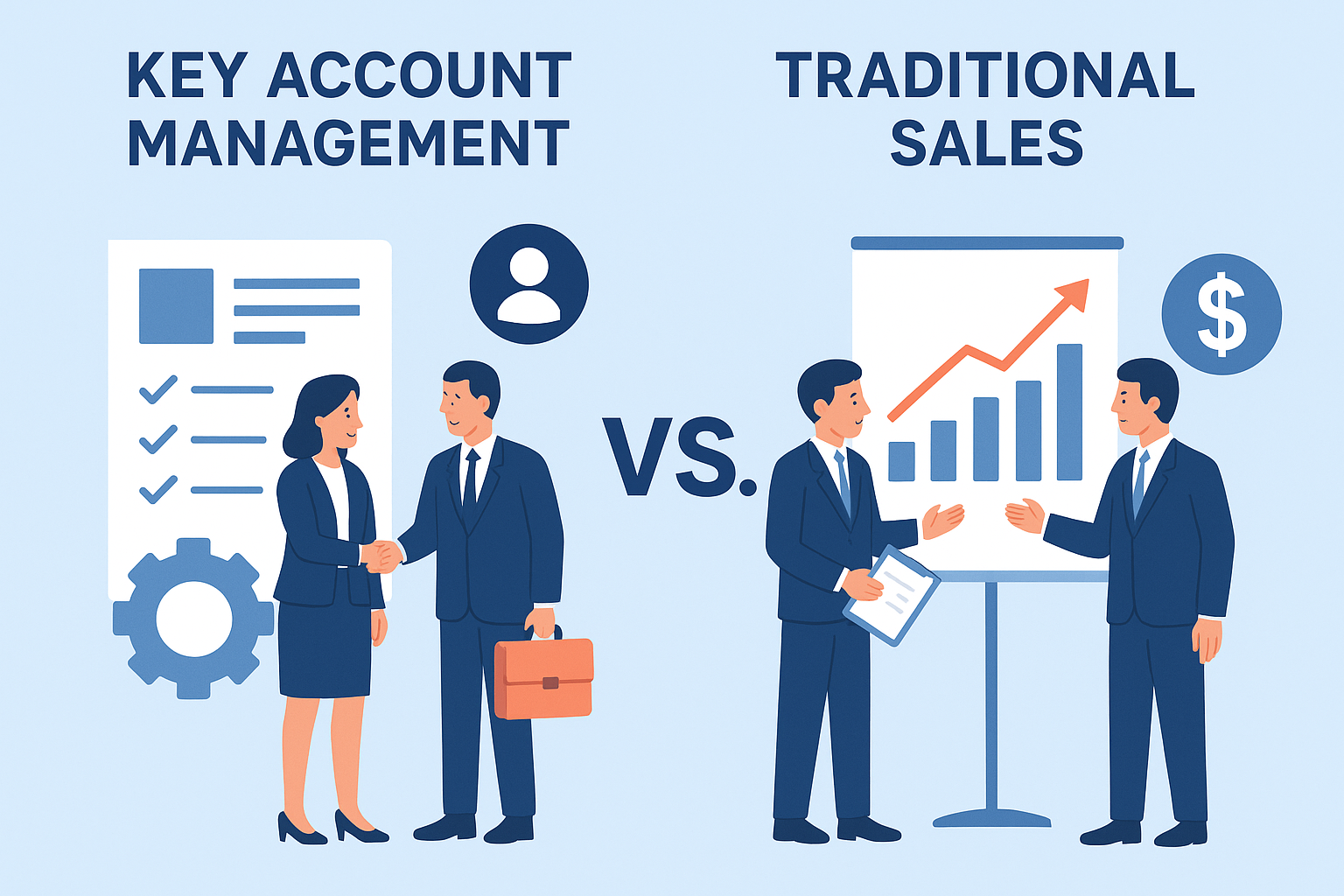
KAM vs. Traditional Sales

Key Account Management vs Traditional Sales: What’s the Difference?

Posted on August 20, 2025 | by Sienna Anderson

When most people think of sales, they picture a salesperson working hard to close deals, hitting their targets, and moving on to the next opportunity. That’s the traditional model—and for many businesses, it still works. But as markets become more competitive and customer expectations rise, companies are realising that not all customers should be treated the same way. Enter Key Account Management (KAM).


At KONA Training, we know that Key Account Management isn’t just “sales with a fancy title.” It’s a completely different mindset and approach—one that focuses on long-term relationships, strategy, and mutual growth.

So, what makes KAM different from traditional sales?

KAM vs. Traditional Sales

The Goal: Transactions vs Relationships

Traditional Sales is about closing deals. The salesperson’s job is to find prospects, present solutions, overcome objections, and secure a “yes.” Success is measured in numbers—how many deals are closed, how much revenue is generated, and how fast it all happens.


Key Account Management, on the other hand, is about building partnerships. A KONA Trained Key Account Manager isn’t chasing quick wins; they’re nurturing long-term relationships with strategically important clients. Instead of focusing on “closing,” they’re focused on “growing”—helping their key accounts succeed so that the partnership thrives over the long haul.

The Timeframe: Short-Term vs Long-Term

In traditional sales, the horizon is often short. The priority is to hit monthly or quarterly quotas, and once the deal is done, the salesperson often moves on.


In KAM, the timeframe is much longer. Key Account Managers are looking years ahead, understanding where their clients are heading and how they can align strategies to grow together. It’s about co-creating value and being seen as a trusted advisor—not just a vendor.

The Customer Base: Many vs Few

Traditional sales usually casts a wide net. A salesperson may manage dozens or even hundreds of customers, giving each a similar level of attention.


Key Account Management flips this model. Instead of spreading thin, KAMs focus deeply on a select group of high-value clients—the ones who contribute significantly to the company’s revenue or have strategic importance. These clients get tailored attention, specialised solutions, and a level of service that goes beyond the standard.

The Approach: Selling Products vs Solving Problems

In traditional sales, the focus is often on the product or service—its features, benefits, and why it’s better than the competition. The conversation revolves around selling what the company already offers.
In KAM, the focus shifts to the client’s business challenges and goals. Key Account Managers spend time understanding their client’s industry, pain points, and strategic objectives. The solutions they bring forward aren’t just off-the-shelf—they’re customised, collaborative, and designed to create long-term value.

The Relationship: Vendor vs Strategic Partner

Here’s where the real difference lies – In traditional sales, customers often view suppliers as one of many vendors they can choose from. The relationship is largely transactional—price, product, and delivery are the main differentiators.


With KAM, the goal is to move up the value chain and become a strategic partner. Key accounts should see their KAM not as just another salesperson, but as someone who understands their business almost as well as they do. That kind of partnership creates stickiness, loyalty, and opportunities for mutual growth.

Strategic KAM

Why KAM Matters More Than Ever

Today’s buyers are more informed, more selective, and more focused on value than ever before. They don’t just want suppliers—they want partners who can help them innovate, grow, and compete.
That’s why Key Account Management has become such a critical capability. Done well, KAM doesn’t just protect your most valuable relationships—it expands them, unlocking bigger opportunities, stronger loyalty, and more sustainable growth.

Traditional sales and Key Account Management both have their place. But if your business relies on a few major clients for a large portion of revenue—or if you want to shift from chasing transactions to building strategic partnerships—then KAM is the path forward.


At KONA Training, we specialise in helping businesses transform their client relationships through tailored Key Account Management Training.

To learn why KONA’s sales training processes are preferred over more traditional sales training methodologies (such as the Miller Heiman sales process) – read more here.

If you’re ready to move beyond traditional sales and build the skills your team needs to become trusted partners, get in touch with KONA Training today.
Call 1300 611 288 or Email info@kona.com.au

Contact Us

Author – Garret Norris – https://www.linkedin.com/in/garretnorris/

Posted in Key Account Management, Sales Strategy, Sales Training | Tagged Australian Sales Training, KAM, KAM Strategy, KAM training, key account management, key account management training, sales team, Sales Training, sales training program
Stop worrying about losing your big clients

Stop Losing Your Biggest Clients: The Key Account Management Training Your Team Desperately Needs

Posted on July 8, 2025 | by Sienna Anderson
Stop worrying about losing your big clients

Losing a big client hurts. It’s a morale killer, a warning sign, and a glaring reminder that something is slipping through the cracks. And more often than not, it comes down to one thing: Your team doesn’t know how to truly manage key accounts.


Generally in most businesses, your top 20% of clients account for 80% of your revenue. These are your key accounts—the most important clients within your company. So, why are they not getting the VIP treatment they deserve?

Why Invest in KONA Key Account Management Courses?

The Dangerous Assumption That Can Cost You Millions

Here’s the trap we at KONA Training see many teams fall into: they assume because a client is loyal now, they’ll stick around forever. Spoiler alert: They won’t.

Today’s buyers are savvier, more demanding, and constantly being ‘wooed’ by your competitors.

If you’re not anticipating buyer’s needs, solving their problems proactively, and deepening the relationship consistently… someone else will. And once a key account starts shopping around, it’s already too late.

Great Relationships Aren’t Enough

“We have a good relationship with them” is not a strategy. Yes, relationships matter. But key account management is more than just remembering birthdays and replying to emails quickly.

A Key Account Manager:
• Has a structured approach to account growth
• Maps the client’s evolving priorities
• Collaborates on long-term strategy
• Knows when and how to introduce new solutions
• Spots early warning signs before they escalate

If your team doesn’t have the key account management skills to do all of the above—and do it consistently—you’re not managing the account… you’re just servicing it.

And, that’s not enough anymore.

Don't wing it

Why Your Sales Team Can’t “Wing” Key Account Management Anymore

Key account management requires a different mindset and toolkit than general sales. It’s not about quick wins or one-off deals. It’s about nurturing the most important relationships in your business with intention, insight, and strategy.

That’s why throwing your best salesperson into a key account manager role without training is like handing someone a scalpel and asking them to perform surgery, just because they’ve watched a few medical documentaries.

What Does World-Class Key Account Management Look Like?

The best KAM teams don’t chase—they lead. They understand the client’s business almost as well as the client does. They become strategic partners, not vendors. And they always have a plan for long-term growth.

KONA Key Account Management Training

With KONA’s Key Account Management training, your team will learn how to:
✅ Build strategic account plans that align with the client’s vision
✅ Spot cross-sell and upsell opportunities without being ‘pushy’
✅ Navigate complex buying structures and multi-stakeholder environments
✅ Strengthen client loyalty even in competitive markets
✅ Have commercial conversations that position your business as essential

Sound like the team you want to have? It’s possible—but only if you invest in the training that builds these capabilities.

Ready to Stop Losing Your Biggest Clients?

If you’ve lost a key client recently—or you’re worried you might—now is the time to act. Don’t wait for another goodbye email to realise the cracks in your account management approach.

At KONA Training, we specialise in tailored Key Account Management (KAM) Training to equip your team with the tools, frameworks, and confidence to grow and retain your most valuable clients.

Protect your Key Accounts

Ready to protect and grow your most important accounts?

Contact KONA today to discuss tailored Key Account Management Training for your team. Let’s stop the client churn and start building relationships that last—and grow.


👉 Visit KONA’s Key Account Management Training Page to learn more, or reach out to our team directly to get started. Call 1300 611 288 or Email info@kona.com.au

Contact Us

Author – Garret Norris – https://www.linkedin.com/in/garretnorris/

Posted in Key Account Management, Sales Training | Tagged KAM, KAM Strategy, key account management, KONA Group, sales team, Sales Training, sales training program
Creating a power map

Mastering Key Account Management with Power Mapping

Posted on May 14, 2025 | by Sienna Anderson
Power Mapping chart

Key Account Management (KAM) isn’t just about maintaining relationships—it’s about strategically growing them to achieve long-term success. But how do you ensure your key accounts stay loyal, engaged, and profitable? The answer lies in Power Mapping, a game-changing technique that helps you navigate complex stakeholder landscapes and make smarter decisions.

We’ll break down what Key Account Management Strategy really is, why Power Mapping is your secret weapon, and how you can use both to dominate your market.

What is Key Account Management Strategy?

Key Account Management is the art and science of nurturing your most valuable customers. These aren’t just any clients—they’re the ones who contribute significantly to your revenue, influence your brand reputation, and have the potential to grow even further.

A strong KAM strategy involves:

✅ Deep understanding of your key accounts’ business goals

✅ Tailored solutions that align with their needs

✅ Proactive relationship-building to stay ahead of competitors

✅ Data-driven decision-making to anticipate risks and opportunities

But here’s the catch—without understanding who holds the power in your key accounts, even the best strategies can fall flat.

Why Power Mapping is a Game-Changer

Imagine walking into a high-stakes meeting without knowing:

  • Who the real decision-maker is
  • Who influences them
  • Who might block your proposal

That’s where Power Mapping comes in. It’s a visual tool that helps you identify:

  • Decision Makers – The people who sign the checks
  • Influencers – Those who shape opinions (e.g., technical experts, consultants)
  • Gatekeepers – The ones who control access (e.g., executive assistants)
  • End Users – The people who will actually use your product/service

By mapping out these roles, you can:

  • Focus your efforts on the right people
  • Avoid wasting time on low-impact contacts
  • Anticipate objections before they arise
  • Build stronger advocacy within the account
Creating a power map

How to Create a Power Map

  1. List all stakeholders – Identify everyone involved in the decision-making process.
  2. Categorise their influence – Who has high, medium, or low power?
  3. Understand their priorities – What motivates them? What are their pain points?
  4. Identify relationships – Who influences whom? Are there hidden alliances?
  5. Adjust your approach – Tailor your messaging to each stakeholder’s needs.

Example:

The CFO cares about ROI and cost savings.

The IT Manager wants seamless integration.

The End User prioritises ease of use.

By addressing each concern, you position yourself as a trusted advisor—not just another vendor.

Putting It All Together: A Winning KAM Strategy

A strong Key Account Management strategy combines relationship-building, strategic insight, and power dynamics. Here’s how:

1. Segment Your Key Accounts

Not all key accounts are equal. Use criteria like revenue potential, strategic fit, and growth opportunities to prioritise them.

2. Develop Account-Specific Plans

Each key account is unique. Create customised strategies based on their business goals, challenges, and stakeholder map.

3. Leverage Power Mapping for Influence

Use your Power Map to:

  • Strengthen relationships with decision-makers
  • Turn influencers into internal advocates
  • Neutralise potential blockers

4. Measure & Adapt

Track engagement, revenue growth, and satisfaction. Adjust your approach based on feedback and changing dynamics.

6 Stages of a Sales Professional

Ready to Elevate Your Key Account Management?

If you want to unlock the full potential of your key accounts, you need more than just goodwill—you need a proven strategy and the right tools.

At KONA, we specialise in tailored Key Account Management training that helps businesses:

🚀 Identify and leverage power dynamics

🚀 Build unshakable client relationships

🚀 Drive sustainable revenue growth

Don’t leave your Key Accounts to chance. Contact KONA today for customised training that transforms your approach to Key Account Management!

📩 Email us at info@kona.com.au or call 1300 611 288 to get started.

Your most valuable clients deserve the best strategy—let’s build it together. 🚀

Contact Us

Posted in Key Account Management, Sales Training | Tagged Australian Sales Training, KAM, KAM Strategy, KAM training, key account management, Key Account Management Strategy, KONA Group, sales team, Sales Training, sales training program

Categories

Recent Posts

  • The Cost of an Inconsistent Sales Process & How to Fix it
  • How Great Leaders Address Underperformance Before It Becomes a Bigger Problem
  • How Better Sales Conversations Can Improve Performance, Accountability and Results
  • How Sales Teams Can Make the Most of the Final Months of 2026
  • Stop Selling to the Wrong Person

Contact Us Now
or Call 1300 611 288

For over 2 decades, our customers have reached out to us because we are an expert Australian team with local and global expertise. We are passionate about empowering individuals and teams growth - developing talents, cultivating leadership skills, and overcome any obstacles.

Let's embark on this transformative journey together.

Limit 2000 Characters

Select list(s) to subscribe to


By submitting this form, you are consenting to receive marketing emails from: KONA. You can revoke your consent to receive emails at any time by using the SafeUnsubscribe® link, found at the bottom of every email. Emails are serviced by Constant Contact

Our team of expert coaches and trainers are dedicated to crafting personalised strategies that align with your unique goals and aspirations. We have the tools and expertise to guide you towards greatness.

By contacting us, you are taking the first step towards transforming your team and achieving the extraordinary.


SYDNEY

Suite 404, 128 Military Rd
Neutral Bay NSW Australia
2089

CENTRAL COAST

Suit 2, 18 Karalta Rd,
Erina, NSW
Australia 2250.

MELBOURNE

Suite 1 | 432 Smith Street,
Collingwood Victoria.
Australia 3066.

LONDON

Suite 1 | 2 Gipsy Hill,
London, SE19 1NL.
United Kingdom.

We cover all States Australia wide including Sydney, Melbourne, Brisbane, Perth, Adelaide and Hobart.

Kona - Sales and Management Training

Hope is not a
Business Strategy

Sales Training

  • Sales Training
  • Call Centre Training & Coaching
  • Sales Management Training & Coaching
  • B2B Sales Training
  • Sales Pipeline Training
  • Power Hour Training
  • Customer Service Training & Coaching
  • Negotiation Skills Training and Coaching
  • Presentation Skills Training
  • Key Account Management Training
  • Story Telling for Sales
  • Sales Activity Calculator

Management Training

  • Train the Trainer / Manager as Coach
  • Team Leader Training
  • HR Strategy
  • Conference and Motivational Speakers
  • Instructional and Course Design
  • Interim Management Services

Locations

  • Sydney Sales Training and Coaching
  • Melbourne Sales Training and Coaching
  • Brisbane Sales Training and Coaching
  • Perth Sales Training and Coaching
  • Canberra Sales Training and Coaching
  • About
  • Our Blog
  • Case Studies
  • Contact

Contact us now on
1300 611 288

Ask KONA AI